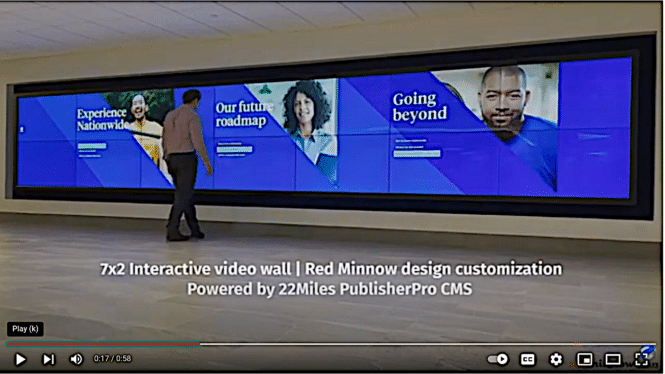
22Miles in cooperation with Red Minnow provides forward-thinking businesses with digital signage and visual communications solutions for the modern enterprise workplace.
In this video, the first phase of the digital transformation of Nationwide Corporate Offices is showcased, with the implementation of a 7×2 Interactive Video wall spearheaded by Red Minnow design customization, all Powered by 22Miles PublisherPro CMS.
Inspire your staff, manage your facility, and keep hybrid workforces aligned and on-mission with a suite of customizable visual communication tools from 22Miles.
Learn more by visiting 22Miles Workplace Management, or to receive a quote for your office, call us at (408) 933-3000
Red Minnow — We’re a tight knit team of designers, developers & technology experts based in Columbus, Ohio. We design and develop mobile applications, interactive experiences and digital signage.
Powered by industry-first Motion Engine technology, this technology has a new store iteration:
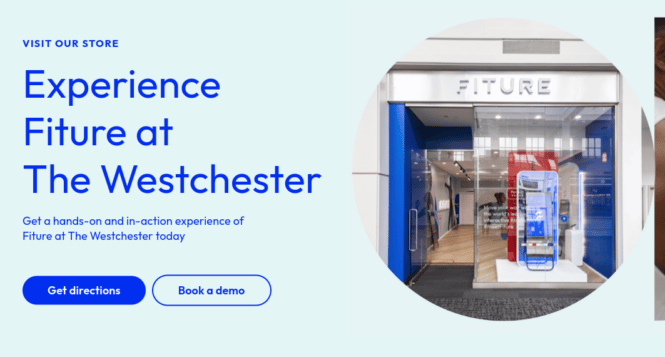
As part of its quest to expand into the U.S., Fiture doubled down on these values and collaborated with MG2 on an immersive and engaging physical space that allowed its Motion Engine technology to shine. The small-but-mighty 605-square-foot space at the Westchester Mall in White Plains, N.Y. opened in November 2022 and brought a burst of activity (and color) to consumers through a vibrant yet intimate space.
Fitting semi-private “zones” and making room for instructors to interact with customers posed as a possible challenge in the small space, but it was needed for Fiture to communicate what’s unique about its platform as the connected fitness space market grows and evolves.
ROI Factors
While many experiential store concepts emphasize dwell time and in-store engagement rates, Fiture is prioritizing KPIs that reflect individuals’ interaction with the product, such as lead generation, traffic-to-demo conversion, demo-to-lead generation and lead conversion-to-sales, according to Cruz. “We will also review the store’s total contribution to overall sales in the key markets it serves, matched with any uptrends in the overall brand awareness in the area. We will use this data to inform any adjustments in strategy, both short- and long-term, to ensure we continue to drive success for our brick-and-mortar strategy.”
Details
Motion-tracking camera scans skeletal points
Gesture Control
No physical controls except for volume — you use your mobile phone
The mirror is never touched (so it stays clean)
Games are available
Interesting to have a mirror hold you accountable and let you know you are slacking. Watching TV for comparison provides zero feedback.
Proximity to screen is important
Very attractive and can go in your living room
For public fitness gyms it makes a lot of sense to offer your customers
Rep counting, pace tracking, real time form feedback and more with Motion Engine™ technology
If you order direct it is $1200 and $25/month membership — 43″ Screen Size
Fiture Core interactive fitness mirror with power cord, magnetic sensor cover, cleaning cloth, and anti-tilt anchor set for simple setup
Complimentary Fit Kit with heart rate monitor, resistance bands (10lb, 15lb, and 20lb), water bottle, and face masks ($150 value)
Thousands of schools around the world are using Rise Vision and one of our partners as an emergency notification solution. All of the applications are easy to use, reduce response time and are loved by school administrators around the globe.
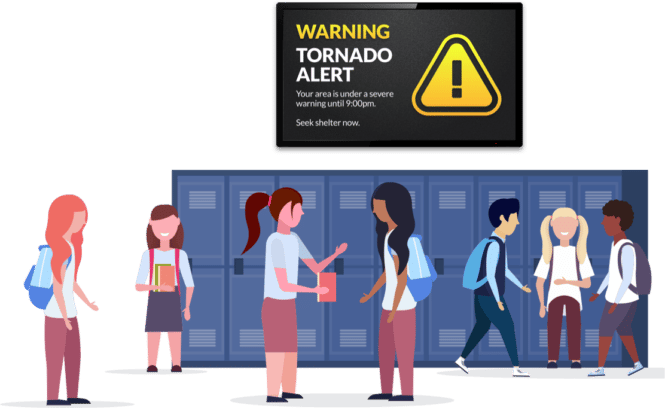
You can display Rise Vision emergency alerts on your passive digital signage displays in hallways, cafeterias, lobbies, libraries, entrances, and more. And you can display emergency alerts on interactive flat panels in your classrooms.
With Rise Vision emergency alerts, you can send emergency notifications to all interactive flat panel displays in your classrooms, like:
With this feature, teachers can go about their day using the screen as a teaching tool. When the display receives an alert, Rise Vision will automatically stop the display from being used as a teaching tool and then show the emergency alert, giving students and staff the necessary time to react.
If your school is in need of emergency notification systems and would like to discuss how Rise Vision can be implemented at your campus, please contact us here.
Peerless-AV’s Megan Zeller Elected to the Digital Signage Federation Board
Megan Zeller, Senior Director, Business Development with Peerless-AV, was recently elected for one of six seats on the Digital Signage Federation Board, marking the highest number of female board members on the DSF Board in years.
Megan Zeller peerless-av
As Senior Director of Business Development, Zeller leads Peerless-AV’s dvLED video wall systems, integrated kiosks, and outdoor AV sales initiatives in the hospitality and gaming verticals. She is responsible for helping her clients develop brand standards with digital signage solutions that are representative of the specific style and quality of the company.
Zeller will take these roles and responsibilities into her new role on the DSF Board to be a larger voice in the digital signage industry with the goal of providing education, networking, and advocacy to continue to innovate and move the growth of the industry forward.
“We are immensely proud of Megan Zeller being elected to the DSF Board,” says Nick Belcore, Executive Vice President, Peerless-AV. “Her passion and dedication to the field makes her the perfect addition to this board to join in the efforts and contributions to the AV industry and work towards a better, more innovative tomorrow.”
The full board will be gathering with members in Louisville, Kentucky on February 15th for the first DSF Meet ‘n Mingle of 2023. The event will feature panel discussions, tabletops featuring products and information from Advisory Council Members. Learn more: https://www.digitalsignagefederation.org/event/louisville-meet-n-mingle/
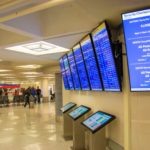
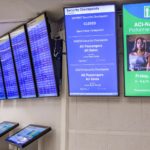
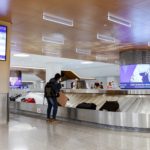
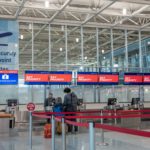
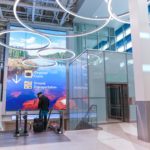
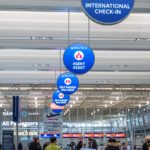
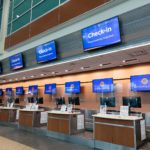
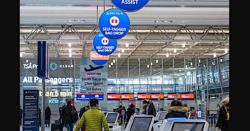
Editors Note: Huge round of thanks to the Metropolitan Airports Commission | Minneapolis-St. Paul International Airport for the generous permission in the use of images below.
MSP has been in the news multiple times for its technology. Future Travel Experienceand Aviation Prosbeing the two most notable. Worth noting that apparently the inspiration for airport management came from what the local baseball team, the Minnesota Twins did (consolidate display information systems). Sixteen-Nine did a nice writeup and names some names.
FTE is a shorter article and covers new DVLEDs installed. We will start with FTE and DVLED.
What is DVLED — Direct View LED is not like regular LED – or any other display. Forget Backlights. It is worth noting that the literal phrase “direct view” is shared by both LG and Samsung.
Direct View LED displays eliminate the LCD panel, instead using a surface array of LEDs as the actual display pixels. This allows for incredible contrast, vibrant colors, and brightness levels several times that of LCDs. Direct View LED displays can also be made virtually any size, including large sizes of 100 feet or more, making them the perfect choice for outdoor and indoor spaces alike. Thanks to the bezel-free design of Direct View LED displays, it’s possible to create seamless video walls too. Explanation of DVLED by LG.
From FTE — new direct-view LEDs mounted above North and South Exit escalators. Actually two displays:
North Exit main display is mounted in landscape orientation and measures 14.75 feet wide and 8.2 feet tall.
smaller ticker-type display with a 2.5mm pixel pitch.
“Digital displays allow us to maximize the use of overhead space at our exit escalators, which was previously used to hang printed messages,” said Eduardo Valencia, Chief Information Officer for the Metropolitan Airports Commission that manages MSP and several regional airports. “We now can schedule and convey important information and offer local businesses a big, bright, bold way to get their messaging in front of visitors.”
Credit: Metropolitan Airports Commission | Minneapolis-St. Paul International Airport
Components
digital signage controller by Radiant Technology Group
LG displays
CMS by Omnivex
AviationPros picked some of this up and did a much more comprehensive article. There is a nice image gallery and the great news is that they started at the South Exit. They have five nice images of the South side and the different iterations of digital signage.
digital signage msp airport
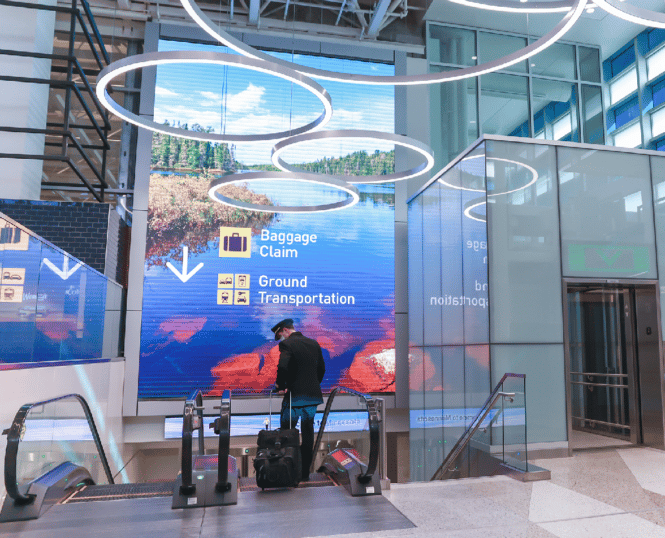
The dynamic digital signage “moons” that Delta uses which can be reconfigured on the fly are probably going to be very handy. Too bad Southwest Airlines didn’t have those for its baggage areas.
Excerpt:
Cross-asset utilization encourages the use of consistent messaging and affords efficiency.
In airports, you sort of have these “fiefdoms,” Valencia said. In other words, he said, “Those displays are only for this purpose.”
“We wanted to leverage all our digital displays in a cohesive integrated way to try to then open up that digital canvas to business (units) for them to use, basically be able to put any message, from any source, data or not, anywhere, any time,” he said.
Comments
“Eduardo and his team have worked thoughtfully to truly transform the MSP Experience. They utilize software (Omnivex) as an enabler for their business and transformative initiatives. We laud their efforts and the partners they chose to support them.” ~Chris Devlin with Omnivex.
“Like many airports, MSP had a very siloed approach to digital signage,” said digital signage expert Neil Bron Chatwood of Omnivex Corporation. “
Work done by Radiant Technology began with consulting, including a multi-year vision and implementation plan, said Doug Freutel, Radiant Technology VP of innovation and visionary.
From LG: In this market you are able to buy the same type of LED cabinets from any OEM, but the differentiator with LG projects, we take pride in providing top-notch onsite installation and in-person training programs that help our client become educated on the whole process and not just a paycheck to us.
Sixteen Nine: The displays add to a digital footprint of more than 800 LG flat panels around the airport. LG PR says the displays were sourced through Bluum Technology, a solutions-focused project designer and technology reseller, and are operated with a custom UX developed by Radiant Technology Group, which then taps into Omnivex’s digital signage software platform.
What the experts say to consider:
Look at your screens – how many are black – what’s the reliability of your current systems?
How many different systems are driving those visuals?
Consider how more valuable those existing screens could be if you had more agility and flexibility in the information you could show on those screens.
Don’t digitize your existing screens, transform them
dynamic or digital wayfinding is huge (see Hartsfield or Sky Harbor articles)
We strongly suggest reading the full article at AviationPros
Complete Samsung Clover ase study on the positive impact that customer ordering kiosks provide to a relatively small retail shop. Video https://youtu.be/UotHJR3DcKs
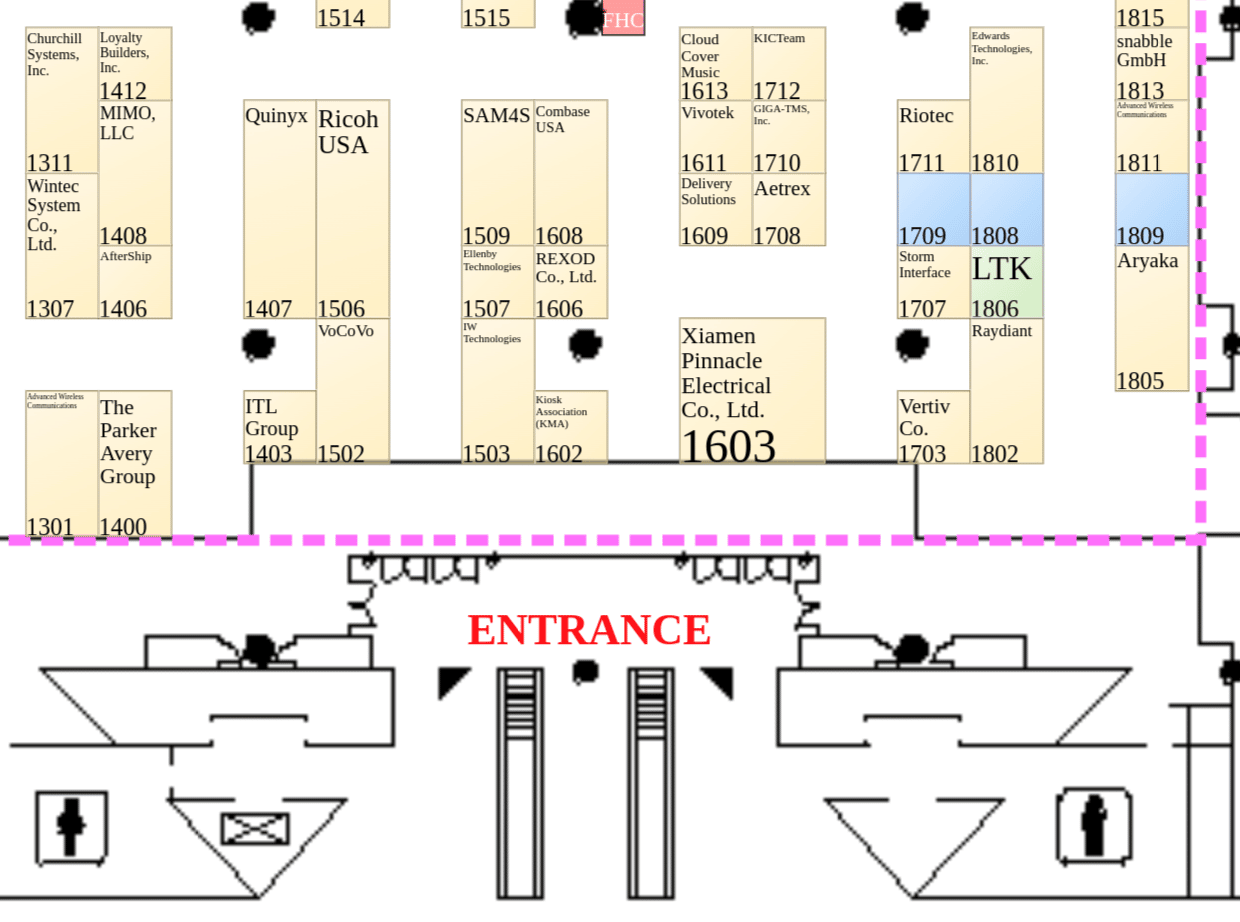
The Pyramid Passport and Flex countertop will be shown in 1602. Both units include assistive technology and one will be running JAWS by Vispero (in McDonalds configuration)
Public access stations & apps can be securely locked down to prevent unauthorized access , and provide remote monitoring tools. KioWare Android does just that. KioWare also includes specific Samsung support for Samsung tablets. https://youtu.be/Ln_Zuv_wIvc
You can see Olea kiosk in the Storm Interface booth nearby the KMA booth at 1602. Stop by and we will walk you over. For more information on Olea Kiosks you can email info@olea.com
DSE Tradeshow aka Digital Signage Experience explores every aspect of digital and interactive display technology, from concept and design to content and analytics.
No matter what business you’re in or where you are on the adoption curve, the DSE tradeshow caters to your needs right now, providing access to hundreds of leading vendors of digital display, interactive technology and content solutions.
See you at DSE in Vegas November 17-19 for Digital Signage Expo. We are in booth 617 and looking forward to the show. Craig is facilitating one of the Lunch sessions.
In our booth
Clover Kiosk by Nanonation – Nano will be highlighting their cloud platform and wide-ranging support. Also at the show Nano will show 3x screens (a Samsung, a LG and a Sony) stacked on a single dual post mount showing our three SoC platforms for signage. For Nanonation show handout DSE_Nanonation Overview-compressed.
5:30PM – 7:30PM DSE Mixer by 16:9 — It will run Nov. 16th at its longtime home, the Hard Rock Cafe on the Las Vegas Strip. As in the past, the event is on the third floor, with a big interior space and a large outside patio overlooking the mayhem on the sidewalk below. The event is free to attend
Thursday Nov 17th
9AM – 9:45AM: Conference Breakouts
10AM – 5PM: EXHIBIT HALL OPEN
10:30AM – 11:30AM: Opening Keynote: Refik Anadol, new media artist
Speaker Case Study – Curved dvLED Displayswith Peerless AV – The new 65,000-square-foot institution leverages the latest in dvLED display technology from LG Business Solutions USA and mounting innovations from Peerless-AV to deliver captivating video content and provide digital canvases for private events or sponsors to display messages and films. Massive Curved Display article on AVIXA for reference
4PM – 4:45PM: Conference Breakouts
5PM – 6:30PM: Opening Night Networking Party. [Sponsored by SONY]
Friday November 18th
9AM – 9:45AM: Conference Breakouts
10AM – 5PM: EXHIBIT HALL OPEN
10:30AM – 11:30AM: Keynote: Jason Cothern, SoFi Stadium
5PM – 6PM: DSE DIZZIE Awards Ceremony and Reception
6PM – 8PM: Crew Up And Connect Industry Party, LDI Circle Bar + Lounge (North Hall)
Saturday November 19, 2022
9AM – 9:45AM: Conference Breakouts
10AM – 3PM: EXHIBIT HALL OPEN
10:30AM – 11:30AM: Closing Keynote: Naveen Viswanatha, Google
11AM – 6PM: LDI Show Floor Open (North Hall, accessible with DSE registration)
12PM – 3PM: Vertical Markets Networking Meet-ups
6PM: LDI Awards Ceremony (North Hall, accessible with DSE registration)
Sunday November 20, 2022 (DSE exhibit floor is closed)
Post-Show Event
10AM – 3PM: LDI Show Floor Open (North Hall, accessible with DSE registration)
Digital Signage Experience (DSE), Live Design International (LDI), and XLIVE are sharing dates in November. Held in separate halls at the Las Vegas Convention Center (LVCC), you’ll receive benefits of the three events sharing dates:
DSE will be held in Central Halls as its own trade show and conference, but your exhibit hall pass will allow you entry into Live Design International (LDI) and XLIVE (North Halls).
Enjoy discounts to conference sessions at LDI and XLIVE: after you register, you’ll receive promotions to use for LDI and XLIVE events and conference.
Questex will combine its capabilities and experience as the leading information and events company focused on the experience economy with input from the industry including past sponsors, exhibitors and attendees to deliver an updated and renewed DSE for the industry going forward.
With an increased focus on reaching key end-user markets for digital solutions and experiences, DSE will harness other audiences and platforms in hotels, hospitality, travel, healthcare, entertainment, education, sensors and communications technology and more.
Learn the latest drive-thru trends taking place across the restaurant industry that are meeting customers’ needs while increasing operators’ revenues. For more information, you can email info@kioskindustry.org
Executive Summary
Once considered an adjunct to an established restaurant, the drive-thru has evolved into an essential business component helping eateries achieve profitability and exceed customer expectations. Drive-thrus are illustrative of a case where technology has helped redefine the dining experience. QSR Magazine cites examples of national chain restaurants that have more than doubled revenues by implementing an effective drive-thru strategy. The drive-thru has become the industry’s most popular off-premises channel having accounted for fifty-two percent of to-go orders in 2021. This growth activity represents an increase of four percent over the prior year.
Most industry practitioners believe restaurant success depends as much on service quality as it does on food quality. The speed and coordination in preparation, as well as the wholesomeness of menu items, are critical factors. Consumers have always sought speed and accuracy with a drive-thru order, but pandemic circumstances amplified guest expectations to include personalization and concise communications. From a drive-thru perspective, clear communications, accurate order entry, and secure payment processing are core technical elements for an effective operation. It is estimated that the average American will spend more than $1,200 on drive-thru food this year. This sum represents a substantial annual increase attributable to the restrictions of the pandemic.
Simply stated, drive-thru’s have become the restaurant industry’s most popular off-premises channel, accounting for more than half of all to-go orders in 2021, according to industry researcher NPD. This business volume represents an increase of four percent over the prior year. During the pandemic, restaurant takeout orders experienced exponential growth. As a result, operators need to continue supporting a multiple-channel approach to off-premises dining that also includes delivery services and order-ahead options, including mobile apps.
According to QSR Magazine, no area has seen more digital improvements than the restaurant drive-thru. Many industry practitioners claim the pandemic made the drive-thru an essential part of keeping restaurants open during lockdowns. It was the sole way to serve customers at eateries across the country continuously. To thrive amid elevated off-premises demand, restaurants have begun investing in innovations designed to maximize delivery, curbside pickup, and drive-thru offerings. These plans for futuristic store models include digitally integrated double and triple drive-thru’s to accommodate mobile orders better, and take out, with reduced on-premises dining room space. For example, consider the two-story Taco Bell in Brooklyn Park, Minnesota that according to tacobell.com was developed featuring four drive-thru lanes, including three lanes designated for mobile or delivery order pickups. The fourth lane will offer a traditional drive-thru experience with face-to-face interaction between customers and staff.
Authors
Michael L. Kasavana, Ph.D., CHTP, CFTP
MSU/NAMA Professor, Emeritus
IFBTA Education
and
Amy Fanale
Sr. Product Manager
Panasonic Connect North America
There is a significant shift in restaurant technology that can engage customers in a way that enhances service, reduces wait times, and increases sales. Digital signage is the technology that powers dynamic menu boards and enables cost-effective influential decision-making at preliminary and point-of-purchase touchpoints.
Excerpt
Executive Summary
There is a significant shift in restaurant technology that can engage customers in a way that enhances service, reduces wait times, and increases sales. Digital signage is the technology that powers dynamic menu boards and enables cost-effective influential decision-making at preliminary and point-of-purchase touchpoints.
It can:
empower restaurants with digital menu boards
queue management techniques
streaming entertainment
and impactful marketing campaigns to increase sales.
This is why 74% of QSRs ranked digital menu boards as a top priority.
Post-pandemic changes in restaurant design, are creating challenges in customer communications in the absence of face-to-face interaction. According to a recent survey conducted by Panasonic, 100% of food service operators found that the COVID-19 pandemic intensified a sense of urgency to adopt transformational technology.
As the foodservice industry experiences challenges with labor and an increase in customer preferences for touchless options, adopting digital technology appears to be even more important. In addition, the evolution of the drive-thru has also underscored the importance of digital signage and customer engagement. Restaurant operators are seeking way to elevate revenues and further enhance the customer experience with digital signage.
The Menu Board
Menu boards have existed for more than forty-five years. The menu boards were initially very simple with copy listing the menu items and their prices printed on a sheet of paper or plastic installed in a lightbox. Some boards were illuminated but no product photography was included. Since restaurants in the 1970s did not offer as many menu items as currently featured, boards were generally smaller in design.
When the need to change items or prices arose, the item insert was removed and replaced with a new strip. Similarly, price chips were updated. Since a menu item was printed on a strip of plastic that slid into tracks, and price chips snapped into place, changes required some dexterity but not altering the entire panel. Static menu boards for drive-thrus also were invented and installed in the 1970s.
The introduction of drive-thru service brought about the addition of outside menu boards and an accompanying communication system. During the next decade, operators learned that photography of menu items increased sales. This led to a space challenge as eateries increased the number of items on the menu and needed room for photos.
These increases in food offerings and photos rendered the board space insufficient. In the 1990s, the introduction of dayparts led to the need for a way to change the content completely to shift from breakfast to lunch to dinner menus. To accommodate daypart changes, meal panels would either be slid over one another at various times of the day or turned around, both manual processes and had to take place regardless of the weather conditions. By the early 2000s menu boards advanced to digital and allowed for video and commercial promotions to emanate from the board without having to go outside. The digitization of menu boards has expanded capabilities while positively impacting revenues, at a cost-effective rate.