TIG / Kiosk Asia Vendor Assessment — August 2026
Canopee Tech is an emerging restaurant technology company built specifically around enterprise digital menu boards and digital signage for restaurant chains.
The instinct with a company this young is to file it under early-stage digital signage startups. That would be the wrong read. Founder Thibaud Denolle spent roughly 12 years at Acrelec, one of the two approved digital menu board hardware providers to McDonald’s globally, finishing as Director of Marketing and CEO of Acrelec America (Business Wire). Canopee’s product strategy therefore comes out of direct exposure to large-scale QSR deployment reality rather than out of adapting a general-purpose CMS to restaurant use.
But the more useful framing for buyers is not that Canopee is new. It is that the top of this market is not fragmented — it is already allocated by contract. Understanding what Canopee is actually competing for is the whole assessment.
The Market Canopee Is Entering
Enterprise restaurant digital menu boards look like a crowded software category from the outside. At the enterprise tier it is not crowded at all. It is three incumbents holding long-dated positions:
-
Coates Group was named McDonald’s single global digital menu board Content Management System provider under a five-year agreement, following a multi-round RFP, and supports approximately 50 McDonald’s markets (QSR Magazine). Its Switchboard CMS is purpose-built for QSR, and the majority of its customers are global QSR brands (Digital Signage Today).
-
Acrelec, founded by former McDonald’s employees, is the other approved McDonald’s DMB hardware provider (QSR Magazine) and reports more than 120,000 solution installations across 70+ markets, over 1,000 employees in 18 countries, and nearly 70 global customers including McDonald’s, Burger King, and Wendy’s (Business Wire).
-
Delphi Display Systems — menu boards, drive-thru timers, voice ordering, and order confirmation across 40,000+ locations in 75+ countries — was acquired by Toast, which explicitly framed the deal as adding drive-thru and digital menu boards to its offering for small and large QSRs (Orange County Business Journal).
Below that sits STRATACACHE/Scala, which has extended its menu board line into QSR automation with Quintet (Sixteen:Nine), and then a large SMB cloud-CMS tier — Yodeck, OptiSigns, Pickcel, Kitcast, NoviSign, Mandoe — where restaurants are one vertical among many (Digital Signage Today).
The consequence: Canopee is not competing for whitespace at the enterprise tier. It is competing for displacement, second-source vendor slots, and the mid-market chains the top three underserve. Every strength and risk below should be read against that.
Company Overview
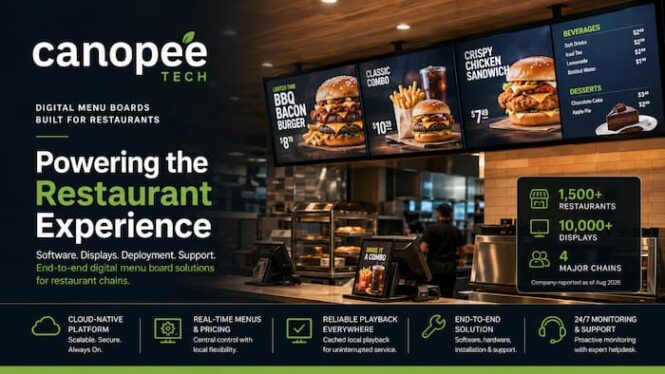
Canopee Tech provides end-to-end digital menu board technology for restaurant brands, spanning software, display hardware, deployment, and ongoing field support (Canopee).
Quick facts
A note on the deployment figures
Canopee’s reported milestone — 1,500+ stores and 10,000+ displays across four major global restaurant chains roughly four months after first pilot — is the single most important claim in this assessment, and it deserves a precise caveat rather than a soft one.
That figure is single-source and founder-reported. It has not been independently corroborated, no customer has confirmed it publicly, and it does not appear anywhere on Canopee’s own website, which as of this assessment carries no customer names, no deployment statistics, no leadership bios, and no stated locations (Canopee). No third-party trade coverage of the company or the milestone was located.
This is not an accusation — early-stage enterprise vendors are routinely bound by customer NDAs, and that alone explains most of the silence. But procurement and competitive analysis should treat the number as unverified until references are produced.
Leadership and Domain Credential
Denolle’s roughly 12 years at Acrelec spanned self-order kiosks, digital menu boards, drive-thru technology, and customer-experience systems. In Acrelec’s 2022 NCR Aloha integration announcement he was identified as Innovation & Marketing Director and articulated a view of digital signage extending well past menu display — dynamic pricing, product outage, indoor video walls, and personalized loyalty-enabled drive-thru journeys (PR Newswire). By Acrelec’s March 2025 rebrand he was Director of Marketing and CEO of Acrelec America (Business Wire).
That is a stronger credential than a product-marketing background: it includes P&L responsibility for the Americas business of a company with McDonald’s-scale deployments.
The credential cuts both ways, and buyers will raise it. The same background that gives Canopee its restaurant-first architecture also makes Acrelec the most probable incumbent being displaced in Canopee’s early wins. Denolle stated publicly on leaving Acrelec that he had already been working for several months on a new QSR digital menu board solution (LinkedIn). Enterprise procurement and legal teams should expect to ask about non-compete scope, IP provenance, and whether the four reported chains are existing Acrelec accounts. Raising the question openly is more credible than omitting it; a clean answer strengthens Canopee’s case rather than weakening it.
Products and Capabilities
Experience Engine — menu board software
Canopee’s stated design goal is letting restaurant marketing teams move without engineering dependency, with local freedom inside a brand frame, frictionless print-to-digital transition, and a path from fast pilot to scale (Canopee).
The central-versus-local tension is the right thing to build around. In franchise networks, corporate standards have to coexist with regional pricing, local promotions, store-level product availability, and market-specific content. Platforms that solve this cleanly win renewals; platforms that force a choice between rigid central control and ungoverned local editing lose them.
Platform foundation
Canopee describes real-time pricing and order confirmation, autoscaling infrastructure on Kubernetes and Docker, fully cached local playback, MFA, granular roles, SSO support, and SOC 2-aligned architecture (Canopee).
Fully cached local playback is the operationally significant item. A menu board that goes dark or stale when the store loses connectivity is a revenue and compliance problem, not a cosmetic one.
Hardware and deployment services
Indoor commercial LCD, digital menu board arrays, large LED walls, and outdoor hardware for harsh environments, plus permitting, installation, commissioning, monitoring, helpdesk, and field support (Canopee). This is a materially more complete model than a CMS-only vendor offers — and it is table stakes against Coates, Acrelec, and Toast/Delphi, all of which already deliver software plus hardware plus services.
Competitive Comparison
The three competitive arguments that matter
1. Architecture recency is Canopee’s genuinely defensible edge. Coates, Acrelec, and Delphi platforms all carry a decade or more of accumulated deployment debt from earlier hardware generations, earlier connectivity assumptions, and earlier security expectations. A restaurant-first stack designed in 2025–26 around Kubernetes, autoscaling, cached local playback, and SOC 2-aligned design from the outset (Canopee) can plausibly beat incumbents on rollout speed and per-store deployment cost. That is precisely the claim the 1,500-store velocity figure supports, and it is why the figure matters more than its absolute size.
2. Toast is the structurally more dangerous competitor than Coates. Coates competes for the same RFPs on similar terms. Toast competes by making the menu board a near-incremental extension of a POS the restaurant already runs — which is exactly why it bought Delphi, framing the deal as enhancing its offering for small and large QSRs alike (Orange County Business Journal). Canopee has no POS. In the fast-casual and mid-market segments where Canopee’s fit is otherwise strongest, Toast can undercut on total cost of ownership simply because it already owns the menu and price data that a menu board consumes. Canopee’s answer has to be integration neutrality and demonstrably better content operations.
3. Displacement economics, not product features, will decide most deals. Ripping out an installed enterprise menu board estate means writing off hardware, retraining marketing teams, rebuilding content libraries, and re-integrating POS. Incumbency in this category is sticky for reasons that have nothing to do with software quality. Canopee’s realistic near-term paths are new-build stores, refresh cycles reaching end-of-life, chains still on static or first-generation digital, and second-source slots in dual-vendor structures — a structure McDonald’s own dual-hardware arrangement demonstrates is normal here (QSR Magazine).
Displacement vs. Greenfield: Where the Real Opportunity Is
The credible five-year Canopee thesis is not that it beats Coates at McDonald’s.
It is that a large population of tier-2 and tier-3 chains — roughly 200 to 2,000 locations — is running static or first-generation digital menu boards, is too small to command sustained attention from the global incumbents, and does not want to adopt an entire POS platform to modernize its boards. That segment has real menu complexity, real franchise governance requirements, real drive-thru needs, and genuinely poor vendor options today.
Canopee’s claimed profile maps onto that segment almost exactly: restaurant-specific logic, central-plus-local governance, indoor and outdoor coverage, and integrated deployment services from a single supplier. It is also the segment where an unproven operating history is least disqualifying, because the buyer is not betting a 40,000-store estate on the decision.
If Canopee wins there and builds a reference base, the enterprise displacement conversations become possible. In the other order, they generally do not.
Deployment Fit Analysis — TIG
Drive-thru deserves the downgrade specifically because outdoor is where this category is hardest: enclosure ratings, high-brightness and thermal management, sunlight readability, ADA and accessibility compliance, municipal permitting, and multi-year hardware SKU commitments. Founder credibility is real here — Acrelec’s outdoor drive-thru work is well documented — but Canopee has published capability claims rather than specifications.
Strengths
Restaurant-first architecture. The platform appears designed around menu operations, pricing, and franchise governance rather than adapted from general-purpose signage (Canopee).
Senior operating credential. Roughly 12 years at Acrelec finishing as CEO of Acrelec America (Business Wire) — P&L-level experience, not just product exposure.
Deployment velocity signal. If verified, moving from first pilot to 1,500+ stores and 10,000+ displays in roughly four months is meaningful evidence that the architecture has cleared pilot conditions and works at multi-thousand-endpoint scale.
Modern enterprise foundation. Cached local playback, autoscaling, SSO, MFA, granular roles, and SOC 2-aligned design (Canopee) address enterprise IT requirements that older platforms retrofitted.
Single-supplier model. Software, hardware, permitting, installation, monitoring, and field service under one contract reduces coordination burden (Canopee).
Considerations
No verified references. Four major chains reported, none named, nothing on the company website, no third-party coverage (Canopee). This is the primary procurement obstacle.
Provenance questions. Buyers should expect to raise non-compete scope, IP origin, and account provenance relative to Acrelec.
No POS of its own. Against Toast in particular, integration breadth and neutrality have to substitute for owning the data layer.
Unproven field-service footprint. Which install, service, and field-support capabilities are delivered by Canopee directly versus regional subcontractors, and in which geographies, is not disclosed.
Lifecycle commitments. Five- to seven-year platform support, hardware SKU continuity, SLA structure, and upgrade path all need contractual definition — the area where young vendors are genuinely weaker, not just perceived to be.
SOC 2 status. “SOC 2-aligned” is not SOC 2 Type II attested. Buyers with audited-security procurement standards should confirm current status and certification roadmap.
Decision Framework
Consider Canopee if:
-
You operate a multi-location restaurant network, particularly in the 200–2,000 store range
-
Menu boards are operational infrastructure, not advertising displays
-
You need centralized brand governance with governed local flexibility
-
Menus involve complex pricing, dayparting, or regional variation
-
You need indoor and outdoor coverage from one supplier
-
You are dissatisfied with incumbent responsiveness and open to a second source
-
You are refreshing an end-of-life estate or building new stores, rather than ripping out recent hardware
Compare carefully if:
-
Your procurement standards require decades of operating history or audited certifications
-
You need substantial non-restaurant deployment evidence
-
You require guaranteed long-term hardware SKUs and contractual lifecycle commitments
-
You already run a mature enterprise CMS and need only displays or players
-
You are a Toast POS customer, where the bundled economics need direct comparison
-
You need dense global field-service coverage across many countries today
Where Buyers Should Investigate Further
Named customer references and permission to contact them; POS and menu-data integrations; dynamic pricing and product-availability behavior; outdoor display specifications, enclosure ratings, and hardware partners; media-player architecture and device management; monitoring and remote diagnostics; SLA and uptime commitments with remedies; geographic field-service coverage and subcontractor structure; SOC 2 status and roadmap; hardware lifecycle and SKU continuity commitments; accessibility and ADA capability; five- to seven-year platform support strategy; and non-compete and IP provenance confirmation.
TIG Perspective
Canopee Tech is unusual among new restaurant technology companies because the company is young and the domain expertise is not. That distinction is real and it justifies attention.
But the useful analytical point is about market structure rather than pedigree. The enterprise digital menu board tier is not an open field — it is held by Coates at McDonald’s under a five-year global CMS agreement, by Acrelec across 120,000-plus installations, and increasingly by Toast bundling Delphi’s menu board and drive-thru technology into a POS platform restaurants already run. A new entrant does not win that tier by being better. It wins by finding the segment the incumbents structurally cannot serve well, proving itself there, and building reference credibility it can carry upmarket.
That segment exists, it is large, and Canopee’s stated design appears aimed at it. The 1,500-store figure, if it holds up, suggests the company already knows this. What is missing is the external verification that turns a founder’s claim into a procurement-grade reference — and until that arrives, Canopee belongs firmly on the watch list rather than the shortlist for a bet-the-estate rollout.
For chains running a refresh cycle, opening new stores, or looking for a credible second source, it belongs on the RFP list now.
FAQ
What is Canopee Tech?
A restaurant technology company specializing in enterprise digital menu boards and digital signage for restaurant chains, spanning software, display hardware, installation, commissioning, monitoring, and ongoing support (Canopee).
Who founded Canopee Tech?
Thibaud Denolle, who spent approximately 12 years at Acrelec and served as Director of Marketing and CEO of Acrelec America (Business Wire).
How many restaurants use Canopee technology?
As of August 2026 the company reported 1,500-plus locations and 10,000-plus displays across four major chains. These are founder-reported figures that have not been independently verified and do not appear on the company’s website (Canopee).
Who does Canopee compete with?
Primarily Coates Group, which holds McDonald’s global DMB CMS contract (QSR Magazine); Acrelec (Business Wire); Toast, which acquired Delphi Display Systems (Orange County Business Journal); and STRATACACHE/Scala (Sixteen:Nine).
Which competitor is the biggest threat to Canopee?
Arguably Toast rather than Coates. Toast can bundle menu boards with a POS that already holds the restaurant’s menu and pricing data, which changes the cost comparison in exactly the mid-market and fast-casual segments Canopee targets (Orange County Business Journal).
Is Canopee primarily a digital signage CMS?
No. It positions as an end-to-end restaurant menu board provider spanning software, infrastructure, displays, deployment, and support (Canopee).
Does Canopee provide outdoor digital menu boards?
The company states it supports outdoor hardware built for harsh environments alongside indoor LCD and LED walls (Canopee). Specifications, enclosure ratings, and hardware partners are not published, so drive-thru buyers should verify directly.
Does Canopee support installation and field service?
Yes — permitting, installation, commissioning, helpdesk, monitoring, and field support are listed as part of the offering (Canopee). Buyers should confirm which are delivered directly versus through regional partners.
Is Canopee SOC 2 certified?
The company describes SOC 2-aligned architecture (Canopee), which is not the same as SOC 2 Type II attestation. Confirm current status and roadmap during procurement.
What should enterprise buyers verify first?
Named customer references with contact permission, POS and menu-data integrations, outdoor hardware specifications, SLA remedies, geographic field-service coverage, SOC 2 status, and multi-year hardware lifecycle commitments.
Notes
Samsung — probably the clearest restaurant/QSR story
Samsung explicitly markets a fairly complete QSR display ecosystem: indoor digital menu boards, exterior menu boards, high-brightness/outdoor products, order-status boards and VXT CMS. Its commercial screens also increasingly incorporate the media-player/OS functionality that previously required separate players.
So I wouldn’t describe Samsung merely as a screen manufacturer. In menu boards, it can occupy hardware + player/platform + device management + CMS.
LG — very similar position
LG is also explicitly pursuing restaurants and QSR. Its portfolio covers indoor DMBs, outdoor/drive-thru signage, window-facing displays, LED, kiosks, webOS and SuperSign CMS. LG specifically promotes centralized menu and price changes and commercial displays designed for 18–24/7 operation.
About the Editor
Craig Allen Keefner is an industry analyst and editor covering digital signage, self-service technology, interactive displays, and restaurant technology. He is the publisher of Digital Signage Blog and executive director of the Kiosk Manufacturer Association, with decades of experience tracking the technologies and companies shaping customer-facing digital systems.
Deployment figures attributed to Canopee Tech are company- and founder-reported as of August 2026 and should be independently confirmed for procurement or competitive analysis.