Nobody Wrote a Standard for the AI in Your Drive-Thru. Europe Wrote Most of One. And what about Vending and other verticals like Lockers, POS, EV Charging, etc. They all orbit our Accessibility Sun. https://kioskindustry.org/drive-thru-ai-regulations/
Digital Signage, Voice AI and Accessibility: When a Screen Becomes an Interface
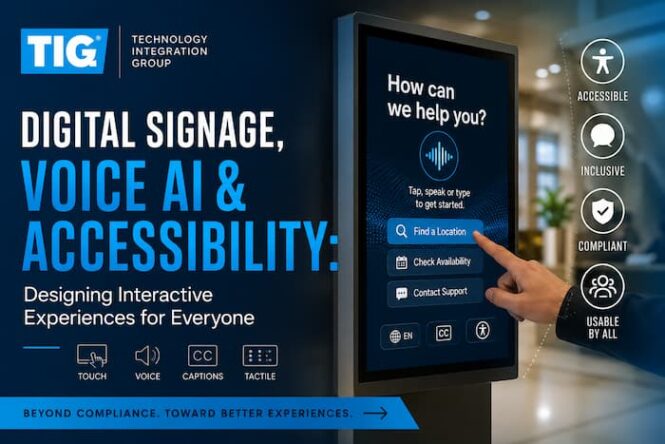
Digital signage is rapidly evolving beyond passive displays. Touchscreens, interactive directories, AI assistants, voice interfaces and transactional displays increasingly blur the line between traditional signage and self-service kiosks.
That distinction matters for accessibility.
A recent Kiosk Industry analysis of voice AI and self-service accessibility regulations highlights an important regulatory gap: U.S. accessibility rules often depend less on what a device looks like than on what the customer is expected to do with it.
Passive Versus Interactive Digital Signage
Traditional non-interactive digital signage remains relatively lightly regulated in the United States. Digital menu boards and building directories, for example, can fall outside portions of ADA signage scoping.
Once the display becomes interactive, however, the situation changes.
A touchscreen directory, wayfinding display, ordering screen or conversational AI interface may require the customer to navigate information, make selections or complete a transaction. Yet current U.S. accessibility standards do not provide one comprehensive technical standard covering all of these devices.
That leaves an important gap between minimum regulatory requirements and genuinely accessible design.
Section 508 Provides a Useful Baseline
Federal Section 508 requirements provide one of the most useful existing technical references for electronic displays.
Among the requirements applicable to federal ICT are specifications addressing variable-message-sign legibility, character presentation, contrast, speech output and tactile controls.
For commercial digital signage operators that may not technically fall under Section 508, these requirements can still provide a practical design baseline.
The Kiosk Industry analysis recommends using the Section 508 reference to ICC A117.1 variable-message-sign requirements as a house standard for electronic display legibility.
Voice AI Creates Another Accessibility Layer
Conversational AI introduces a different set of issues.
The fundamental principle should be simple:
Voice should never be the only way to complete a transaction or access essential information.
Speech recognition can perform very differently for people with stutters, dysarthric speech or other speech disabilities. Deaf and hard-of-hearing users face an even more fundamental problem with voice-only systems.
An accessible conversational interface should therefore provide another path, such as touchscreen or text interaction, along with visual confirmation of what the AI understood and a way to reach human assistance without first having to successfully communicate with the voice system.
Europe Is Further Ahead
The regulatory landscape is clearer in Europe.
The European Accessibility Act has applied to covered products and services since June 28, 2025, while EN 301 549 provides detailed ICT accessibility requirements. Significantly for AI deployments, EN 301 549 includes requirements for alternatives to voice-based services.
For multinational digital signage and self-service suppliers, this creates an interesting situation: accessibility capabilities required or supported for European deployments may already exist even when equivalent U.S. regulations have not yet caught up.
Interactive Signage Should Be Treated Differently
The practical takeaway for the digital signage industry is to stop treating every screen as the same product category.
A passive advertising display is one thing.
An interactive directory, touchscreen menu, wayfinding kiosk, AI concierge or conversational display is another.
Once the customer must interact with the screen to obtain information or complete a task, designers should consider accessibility requirements involving screen readability, reach, alternative input, speech output, captions, tactile controls and non-voice alternatives.
The safest approach is also the simplest: design interactive signage for independent use rather than designing only to the minimum regulatory requirement.
As displays become intelligent interfaces, accessibility becomes part of the user experience—not simply a kiosk compliance issue.
Adapted from the Kiosk Industry analysis “Nobody Wrote a Standard for the AI in Your Drive-Thru,” which examines U.S., European and Canadian accessibility requirements for voice AI, kiosks, digital signage, vending, lockers, smart-city displays and EV charging.