Digital signage is no longer a display market. It is a technology and services stack, with the competitive battle increasingly centered on who controls the platform, data, lifecycle and customer relationship
That is also consistent with invidis’ very recent analysis that the market is becoming less about individual brands and more about roles and points of accountability, particularly as managed services expand. Invidis
Europe has written the rulebook for interactive self-service and the U.S. has not, while signage vendors are walking into interactive territory without noticing they just crossed a legal boundary. Accessibility is the sun, as you put it — and the accessibility test is now a verb test, not a device test.
Digital Signage in 2026: The Screen Is Only the Beginning
Digital signage is everywhere.
Walk through an airport, shopping center, hospital, university, hotel, restaurant or transportation terminal and displays have become part of the physical infrastructure. They provide directions, advertise products, display menus, communicate schedules, deliver emergency information and increasingly provide interactive services.
But there is a basic problem with digital signage that receives far less attention than display resolution, content management or artificial intelligence:
Who knows when the screen isn’t working?
A black screen in a public environment is more than an equipment failure. A frozen display, disconnected player, failed application, lost network connection or screen showing stale information represents a failure of the entire digital signage system.
The kiosk industry has dealt with this problem for decades.
An unattended kiosk is expected to report whether it is alive (heartbeat), whether its application is running, whether peripherals are functioning, whether communications have failed and—in mature deployments—whether the problem can be corrected remotely before anyone gets into a truck. Redundant “fallback” cellular connections are common.
Digital signage increasingly needs the same operational discipline.
Digital Signage Is Infrastructure
The traditional description of digital signage is deceptively simple:
Display + media player + CMS + content.
That was adequate when the principal objective was replacing a printed poster with a scheduled digital image.
It is increasingly inadequate.
Modern digital signage can include:
Commercial displays and LED
System-on-chip processors and external players
Operating systems
Content management systems
Cloud services
Networks
Sensors
Touchscreens
Cameras
Audio
APIs and data feeds
Analytics
AI
Accessibility technology
Remote device management
Security
Field service
Add menu boards, interactive wayfinding, retail media networks, transportation information, digital out-of-home and public information systems and it becomes clear that digital signage is no longer a screen market. It is a distributed technology infrastructure.
And distributed infrastructure has to be managed.
The Dead-Screen Problem
Everyone who works around public-facing technology has seen it.
A digital sign is black.
A display shows an operating-system error.
A menu board has three functioning screens and one dead screen.
A wayfinding display is frozen.
A screen is powered on but the application has stopped.
Content is running but hasn’t been updated.
The display is operational but has lost its network connection.
Or perhaps everything appears normal from a CMS dashboard because the CMS successfully delivered a file yesterday—but the screen the customer sees today isn’t actually displaying it.
That last distinction is important.
Content management is not the same thing as endpoint management.
Knowing that content was successfully published does not necessarily tell an operator that the public-facing display is healthy.
What Digital Signage Can Learn From Kiosks
Remote monitoring has been a fundamental requirement for serious kiosk deployments for decades.
A kiosk management platform may monitor:
Heartbeat
Application status
CPU and memory
Storage
Network connectivity
Device temperature
Software versions
Peripheral status
Usage
Error conditions
Security events
It can also provide:
Remote access
Application restart
Device reboot
Remote power cycling
Configuration changes
Software updates
Batch deployment
Reporting
Alerts
Escalation to field service
Digital signage needs the equivalent.
For signage, that means monitoring not merely the player but the complete experience:
Is the player alive?
Is the application running?
Did the content download?
Is the display powered on?
Is it on the correct input?
Is the display actually producing an image?
Is the network available?
Is the content current?
Is the screen operating within temperature limits?
Can the problem be corrected remotely?
If it cannot, has a service ticket automatically been created?
That is the difference between remotely distributing content and remotely operating a digital signage network.
The Industry Is Moving Toward Managed Signage
This change is already underway.
The industry increasingly uses terms such as remote device management, managed signage, device orchestration and managed services.
That evolution is important because many existing signage networks are inherently fragmented.
One organization might have Samsung displays in one generation of stores, LG displays in another, external media players at older sites and system-on-chip displays at newer ones. Different divisions may have selected different CMS platforms. Acquisitions add another layer of technology.
Years later, the organization isn’t operating a standardized digital signage product.
It is operating a fleet.
And fleets need fleet management.
Replacing everything simply to standardize management can be enormously expensive. The better answer increasingly will be an orchestration layer capable of managing heterogeneous installed equipment.
From CMS to RDM
The CMS remains essential, but its job is primarily answering:
What should this screen display?
Remote device management answers a different question:
Can this screen actually display it?
The strongest digital signage architectures increasingly need both.
Some vendors are already combining the two.
Samsung and LG integrate device-management capabilities into their commercial signage ecosystems. Signage platforms are extending further into endpoint management. Amazon has exposed remote-management capabilities for its Signage Stick, with CMS providers including ScreenCloud and NoviSign integrating those controls.
5. Content / Data / Experience
Creative content, APIs, real-time information, analytics, AI and interactive experiences.
6. Integration & Deployment
Engineering, networking, mounting, installation and commissioning.
7. Managed Services
Remote monitoring, helpdesk, NOC, security, field service and lifecycle management.
8. Vertical Solutions
Restaurant menu boards, retail media, corporate communications, healthcare, transportation, hospitality, education and DOOH.
The important development is that the boundaries between these layers are disappearing.
Display manufacturers are adding software. CMS companies are adding device management. Player companies are moving into embedded systems. Integrators are offering managed services. Cloud platforms are reaching further down into endpoint hardware.
The strategic question is becoming:
Who controls the stack?
Accessibility Makes Operational Management Even More Important
Accessibility was actually one of the reasons for revisiting this market. It reminds us of the ATM market. Totally legislated and in place but often deliberately neglected or postured. And a declining market
Digital signage and kiosks increasingly overlap and one reason is the advent of AI and conversational AI. Does the customer merely look at the screen, or do they use it?
A passive advertising display is one thing. Add touch, wayfinding, ordering, ticketing, check-in, voice, QR interaction or another public service and the system begins moving toward interactive self-service.
That introduces another question:
Is the accessible experience working right now?
Accessibility cannot be treated exclusively as a design-time checklist.
Imagine an accessible interactive display with audio output.
The interface was properly designed. The deployment passed its accessibility testing. The accessible mode worked at commissioning.
Six months later the audio service stops.
Is the system still accessible?
Technically having an accessibility feature is of little value if nobody knows when that feature fails.
That suggests a more mature approach:
Accessibility should become a monitored system state.
Where technically possible, remote management should verify the availability of accessibility-related hardware and software just as it verifies the player, network and display.
That could include audio services, accessibility applications, connected input devices, peripheral health and application versions.
This is an area where the experience of the kiosk industry could be particularly valuable to digital signage.
The Global Accessibility Question
The issue becomes even more significant globally.
Accessibility requirements are evolving across the United States, Europe and Asia, while public-facing digital systems are becoming increasingly interactive.
The distinction between a “digital sign” and a “kiosk” is consequently becoming less useful.
A 55-inch screen may begin as a digital directory. Add touch and it becomes interactive wayfinding. Add QR continuation and it becomes part of a mobile transaction. Add voice and AI and it becomes a conversational interface.
The hardware may look like digital signage.
Functionally, it is becoming self-service.
That means accessibility, cybersecurity, privacy, monitoring and lifecycle management need to be considered at the system level, not according to what marketing category was printed on the purchase order.
Where Industry Suppliers Fit
The digital signage ecosystem includes companies operating at very different levels of this stack.
For example, LG Electronics Business Solutions provides commercial display infrastructure, while LG-MRI/BoldVu specializes in high-brightness outdoor display environments.
Peerless-AV addresses the physical deployment layer with mounts, outdoor displays and infrastructure.
Companies such as 22Miles and Acquire Digital operate higher in the stack around digital signage, interactive experiences and wayfinding.
Nanonation spans digital signage and custom interactive software.
SiteKiosk is particularly relevant to the convergence discussion because its background in kiosk lockdown and remote monitoring extends into digital signage and content management.
Touchscreen specialists including Insight Touch and TDS TOUCH become important as signage moves from passive presentation toward interaction.
Media-player and computing suppliers address another layer entirely.
No single one of these categories constitutes “digital signage.”
Together, they illustrate why the market should be viewed as an ecosystem.
The Next Competitive Layer: Uptime
Display quality will continue improving.
LED will become more sophisticated. System-on-chip platforms will become more capable. AI will generate and personalize content. Analytics will become more precise.
But none of those features matter when the screen is black.
The next major opportunity may therefore be less glamorous:
Make every deployed screen observable, manageable and recoverable.
A mature digital signage network should know the operational state of every endpoint.
It should identify failures before the customer does.
It should attempt automated recovery.
It should distinguish a content problem from a network problem, player problem or display problem.
And when remote recovery fails, it should provide the information needed to send the correct technician with the correct replacement component.
The kiosk industry has been working toward that model for decades.
Digital signage now has millions of distributed public endpoints and increasingly complex software, networks and interactive services.
It is time to apply the same discipline.
TIG Perspective
Digital signage has historically devoted enormous attention to what appears on the screen.
The next phase needs to devote equal attention to whether the screen—and everything behind it—is actually working.
The industry’s transition from CMS-centric signage toward remotely managed infrastructure may ultimately be more important than another generation of higher-resolution displays.
This is particularly true as digital signage becomes interactive, transactional, personalized and subject to accessibility requirements.
The future digital signage platform will not simply publish content.
It will know the health of the endpoint, understand the customer experience, detect failures, recover automatically where possible and coordinate service when it cannot.
A screen you cannot monitor is a screen you cannot depend on.
Vertiseit’s acquisition of Scala is a major software-platform transition. For enterprise operators, the first task is not necessarily a CMS migration—it is understanding exactly which company owns each part of the operating stack.
Vertiseit completed its acquisition of the Scala business in May 2026, taking control of Scala shares and assets for approximately SEK 265 million. Vertiseit says Scala will continue as a strategic software offering within Dise, with a partner-first strategy, expanded hardware flexibility, and a gradual move toward SaaS and device-agnostic delivery.
Our interests cover retail, healthcare, corporate, education and QSR. We never expected Stratacache to disappear before our eyes, but they have. Things change for sure.
The publicly established sequence is simply:
STRATACACHE acquired control of Scala in August 2016.
STRATACACHE completed full ownership in February 2018.
Scala remained in the group for roughly a decade from initial control, or a little over eight years from full ownership.
Vertiseit agreed to acquire Scala on May 20, 2026 and completed the purchase June 1, 2026.
That is a significant and potentially positive continuity story for Scala users. But it is also a moment when restaurant, retail, transportation, and other enterprise operators should look carefully at their real digital-signage dependencies.
The key distinction: Scala software, STRATACACHE group relationships, systems integrators, content operators, media-player vendors, field-service providers, and managed-services contracts are not automatically the same thing.
The Scala transaction
Scala remains one of the industry’s best-known enterprise digital-signage software brands. Vertiseit describes it as a platform with a global installed base, more than 100 partners, and more than 1,000 brand customers across retail, QSR, grocery, automotive, airports, convenience, and other verticals.vertiseit
Vertiseit’s stated direction is clear:
Scala continues within the Dise organization.
The go-to-market model is intended to be partner-first.
The product direction emphasizes SaaS, cloud capabilities, hardware flexibility, and device-agnostic operation.
Vertiseit expects the acquisition to add roughly SEK 85 million in recurring SaaS and maintenance revenue and approximately SEK 200 million in annual total revenue based on Scala’s previous performance.vertiseit
For many customers, that could mean a more focused software business with a clearer channel model. The important point, however, is that an enterprise signage deployment is rarely just a software relationship.
A large multi-site deployment may include a CMS, media players, display hardware, network connectivity, content production, menu or pricing workflow, APIs, data integrations, monitoring, field replacement, help desk, and regional deployment management. Those components may sit with different companies and under entirely different contracts.
Why contract mapping matters
Public reporting has documented wider changes affecting portions of the STRATACACHE group, including liquidation of Stratacache U.K. and PRN U.K. in May. That fact does not establish the status of any other STRATACACHE entity, customer agreement, or service contract. It does, however, reinforce why customers should know who their actual contractual and operational counterparties are.adweek
The question is not simply:
“Are we a Scala customer?”
The better question is:
“Who is responsible for every essential part of our digital-signage operating model—and what happens if one of those relationships changes?”
Three common positions
Deployment position
What Scala’s new ownership may mean
The practical issue
Direct Scala software customer
The CMS brand, ownership structure, roadmap, and commercial relationship move into Vertiseit/Dise
Confirm the renewal entity, maintenance entitlement, support path, roadmap, and product lifecycle
Partner-led Scala deployment
A systems integrator, AV provider, agency, or managed-service provider remains the primary operational relationship
Confirm that the partner’s support, hardware, device-management, and escalation model remains intact
Broader managed-service deployment using Scala
Scala may be just one software layer in a solution that also includes hardware, content, network, deployment, or support
Separate the software dependency from the service contract, SLA, field-support model, and operational obligations
That mapping exercise is relevant whether an operator stays with Scala, expands it, modernizes its architecture, or evaluates alternatives. It is not an argument that every customer should migrate. In fact, for many enterprises, a well-supported existing deployment will remain the lowest-risk choice.
Enterprise checklist
Use this checklist before a renewal, expansion, technology refresh, service transition, or procurement review.
1. Identify the legal counterparties
Who holds the software license or SaaS subscription?
Who provides maintenance and technical support?
Who owns the managed-service agreement?
Who supplies and warranties players, displays, mounts, networking, and replacement parts?
Who has responsibility for field service and on-site repair?
Is the customer contracting with the software vendor directly, a channel partner, an integrator, or a broader managed-services provider?
A single project can have five or more counterparties. Do not assume that a CMS ownership change automatically transfers or changes all related obligations.
2. Map the Stack
CMS and content authoring tools.
Playlist, scheduling, approval, and campaign workflow.
Media-player hardware, operating system, remote device management, and security patching.
Display models, firmware, warranties, and power/network dependencies.
POS, menu-management, product, pricing, loyalty, inventory, analytics, and API integrations.
Content feeds, creative agencies, menu boards, retail-media workflows, and proof-of-play data.
Identity management, permissions, audit records, backup, disaster recovery, and data retention.
For QSR and convenience environments, menu pricing, daypart changes, promotions, nutritional information, and POS synchronization may be business-critical. A signage problem can become an operations problem quickly.
3. Confirm service accountability
What is the support SLA by severity?
Who receives the first call when a screen fails?
Who owns remote diagnosis versus truck-roll responsibility?
What are the replacement-player and replacement-display logistics?
What are the escalation contacts for nights, weekends, and promotional periods?
Does the service model cover all operating regions and franchisee or subsidiary structures?
Are existing service commitments documented in the contract, or simply assumed from past practice?
The software platform can be stable while the operational model around it is unclear. Customers should test both.
4. Protect Your Content
Can you export content, templates, playlists, media libraries, device inventory, user roles, campaign histories, and proof-of-play records?
Are APIs documented and available?
Who owns the data generated by the deployment?
What happens to access if a contract ends or changes hands?
Are backup and recovery procedures tested?
Can a new provider take over without rebuilding the entire content library?
Data portability is not just a migration issue. It is a negotiating and continuity issue.
5. Verify the roadmap
Vertiseit has publicly stated that Scala is expected to evolve toward a modern SaaS-based and device-agnostic offering, while remaining part of a partner-first strategy. Customers should ask how that plan applies to their specific deployment—not just the next product demonstration.vertiseit
Ask:
Which current Scala products and deployment modes remain supported?
What is the timetable for cloud, SaaS, security, and platform changes?
Will existing on-premise or hybrid deployments continue to receive fixes and support?
Which existing player types, operating systems, and display hardware remain certified?
Are there costs or operational changes associated with moving toward SaaS?
How will partner roles change, if at all?
What level of backward compatibility is committed in writing?
6. Maintain an exit option
Every enterprise should know its exit path before it needs one.
What are the termination and renewal rights?
What notice periods apply?
Is customer consent required for contract assignment or novation?
What licenses, hardware, content, data, and integrations survive a contract termination?
Can the operator retain or export essential deployment information?
What will a phased migration cost in time, labor, hardware, testing, and store disruption?
Which systems cannot fail during a transition?
An exit plan does not mean an operator intends to leave. It means the operator understands its operating risk.
The market implication
The Scala transaction is not a simple “winner and loser” story. It is a case study in how mature digital-signage deployments are changing.
The industry is moving away from a view of signage as a standalone screen-and-player project. Enterprise buyers increasingly evaluate a connected operating stack:
Content and campaign execution.
Device and endpoint management.
Cloud architecture and security.
POS, menu, product, pricing, and analytics integration.
Field service and deployment capacity.
Partner accountability.
Data rights and operational continuity.
That favors suppliers that can be explicit about roles. A software company should be clear about its roadmap, APIs, license terms, and channel support. An integrator should be clear about deployment, service, hardware, and escalation. A managed-services provider should be clear about its SLAs, monitoring, field coverage, and operational ownership.
The customer’s job is to make sure those promises join up into one functioning operating model.
Addendum
Competitive Angles for other software companies illustrates the delicate balance between “we are all in on retail” which comes with the subsequent “maybe not so much anymore here” routine?
The opportunity for 22Miles and DX Pro
The opportunity is not automatically a “rip and replace” wave. It is an opportunity for discovery and selective modernization.
22Miles is particularly well positioned for interactive wayfinding, smart-campus, workplace, healthcare, and visitor-experience programs—use cases where a standard retail signage CMS is only part of the solution. Its own marketing has already tried to turn the acquisition into a migration message to non-retail Scala customers, which shows the competitive narrative is underway; that is marketing, not proof that customers are leaving.linkedin
DX Pro can be positioned in the same conversation if its current product capabilities support enterprise communication, wayfinding, workflows, integration, or managed signage operations in the verticals you name. The article should avoid presenting DX Pro as a generic replacement without demonstrating a specific fit against the customer’s required workflows, deployment model, security, integration needs, and support footprint.
Not a fan of 22Miles? Then look at AcquireDigital and Nanonation!
Addendum – What Happened With Stratacache
This is a personal take look at Stratacache. At one point I was pursuing them and trying to get my foot in the door. Several companies I have worked with were approached to be purchased. SC seemed moving toward titan stage.
I believe my thesis is plausible in its overall direction, and recent industry reporting now supports several of its most important observations: STRATACACHE was acquisition-led, expanded aggressively beyond QSR, made a substantial U.S. manufacturing bet, suffered a real 2026 retrenchment, and has begun selling assets—including Scala. But the strongest version of the argument is that this was an interlocking strategic, operational, and financing problem, not yet a provable “the banks pulled the plug” story. Dayton
Personal perspective on STRATACACHE
None of this is especially surprising. STRATACACHE appeared interested in acquiring a wide range of adjacent companies; Acrelec was reportedly among the targets, and the broader pattern suggested an acquisition-led effort to assemble scale across digital signage, QSR technology, retail technology, software, and hardware.
What follows is my personal interpretation, not a statement of verified fact. I do not have access to STRATACACHE’s internal financials, lender discussions, acquisition terms, or board-level decisions.
A shift away from QSR
Element of our theory
Match with public evidence
Plausibility
STRATACACHE pursued an aggressive acquisition strategy
Strongly supported. The company says it evaluated more than 400 deals annually and completed 14 acquisitions over 18 years; Scala, Walkbase, PRN, RDM, X2O, and other assets reflect that strategy.
High
STRATACACHE shifted toward retail and broader in-store experience
Supported. Its own market positioning includes retail, grocery, finance, retail media, analytics, displays, and shopper engagement alongside QSR.
High
QSR became less secure, especially McDonald’s
Supported in the important sense that McDonald’s named Coates its single global DMB CMS provider in 2022; Coates was also one of two approved hardware providers. That is a material strategic displacement of STRATACACHE’s U.S. incumbent role.
High
Retail diversification did not offset QSR weakness
Reasonable, but not publicly quantifiable. The logic is sound; there is no public segment revenue disclosure sufficient to prove retail underperformed QSR or to validate a 15% figure.
Medium-high
Large fixed-cost manufacturing/real-estate investments hurt the business
Strongly plausible. The Oregon MicroLED project, Dayton/Trotwood industrial investment, and capital intensity of display manufacturing are well documented.
High
Display reliability/service economics created customer friction
Plausible but weakly documented in public sources. Treat Taco Bell burnout/filter claims as market intelligence or anecdotal evidence unless supported by contracts, service bulletins, failure-rate data, or customer testimony.
Medium
Layoffs were a response to serious financial distress
Supported. STRATACACHE confirmed layoffs; multiple industry reports subsequently described liquidation of subsidiaries and asset sales.
High
Lenders/investors withdrew support or forced restructuring
A credible inference, but unproven. Public reporting shows distress and monetization, not the internal lender covenants, debt stack, or bank decisions required to state this as fact.
Medium-high as a hypothesis
My view is that STRATACACHE gradually shifted attention away from its original QSR strength and toward broader retail. By then, it had already secured major restaurant brands, notably McDonald’s and Restaurant Brands International, while also acquiring Scala after Scala had won the Taco Bell digital-signage opportunity.
The strategic logic was understandable: once a company has won many of the largest QSR opportunities, retail represents a much larger potential addressable market. The shift was visible externally as well. At industry trade shows, STRATACACHE’s presence appeared to feature progressively less restaurant-specific content and more retail-oriented messaging, merchandising, and in-store experience technology.
However, retail is fundamentally harder to standardize than QSR. A restaurant chain can often deploy a repeatable product model across stores: menu boards, drive-thru, order status, promotional display, kitchen communications, and related workflows. Once a supplier has built a credible solution for one large chain, much of that architecture can be adapted for another.
Retail is different. Two retailers may both use displays, but their requirements can be radically unlike one another: product categories, store formats, promotional calendars, merchandising rules, inventory integrations, customer journeys, screen placement, content ownership, and store labor models vary enormously. The “common denominator” is much smaller.
Acrelec’s experience is illustrative. Despite a significant QSR footprint, what it described as diversification beyond its core restaurant business remained a comparatively limited share of global revenue—roughly 15 percent by this account. That suggests how difficult it is to convert an established QSR technology position into a scalable retail platform.
Execution and customer experience
My impression is that the strategic shift may also have affected execution in the core QSR business. There were reports and customer complaints around the speed of campaign setup, with some customers allegedly facing four- to six-week turnaround times for new marketing campaigns. In an environment where QSR operators increasingly expect quick promotions, daypart changes, price updates, limited-time offers, and localized content, that kind of lead time is a competitive weakness.
There were also visible competitive changes in the market. McDonald’s decision to move to Coates as its single global DMB CMS provider was a major strategic loss of position for STRATACACHE, even if the precise U.S. migration timetable and residual STRATACACHE footprint are not publicly disclosed. I would not attribute that transition to any one issue—large enterprise technology transitions almost never have a single cause—but it is consistent with a broader picture of pressure on STRATACACHE’s historical QSR position.
The concern is not simply that a customer is lost. It is that the QSR base historically provided the recurring revenue, brand credibility, deployment scale, and customer reference base needed to support ambitious expansion into other verticals. If that base begins to weaken while retail growth is slower than anticipated, the economics become much more difficult.
STRATACACHE still publicly marketed a major QSR position in early 2026, claiming digital menu board work for eight of the top 10 QSR brands in the United States and more than 650,000 digital menu boards globally. That is company marketing rather than independently audited revenue data, but it shows QSR remained a key claimed vertical rather than a business it had abandoned entirely.
Acquisition-led expansion
STRATACACHE did not grow organically in a narrow software-only way. It built a group through acquisitions across signage software, retail media, analytics, display hardware, integration, and service. Its own company page states that it has made 14 acquisitions over 18 years and reviews more than 400 possible deals a year. stratacache
The Scala transaction is central to the argument. STRATACACHE acquired super-majority control of Scala in 2016, but the original transaction terms were not publicly disclosed. Therefore, “roughly $100 million” should be presented as an industry estimate rather than a confirmed price. Contemporary coverage said no deal terms were released and suggested Scala’s annual revenue had been around $25 million, making a large acquisition price possible but not demonstrable from public evidence. qsrmagazine+2
The more revealing data point is the exit: Vertiseit announced in May 2026 that it was acquiring Scala from STRATACACHE for about SEK 265 million—approximately €24 million—through shares and assets. invidis+2
That does not establish a loss on Scala, because the original price, intervening cash flow, investments, asset mix, and deal structure are unknown. But selling one of the group’s most recognizable software assets during a broader period of retrenchment is consistent with a need to simplify, raise liquidity, or reduce financial pressure.
Acquisition, leverage, and manufacturing
The more important issue, in my view, may have been the financial model behind the expansion.
STRATACACHE acquired a substantial number of companies. Scala alone was reportedly acquired for approximately $100 million in 2016, although the precise transaction value and financing structure are not public. An acquisition program of that scale commonly depends on some mixture of debt, lender confidence, projected synergies, growth assumptions, and future cash flow.
The highest-risk strategic decision may have been the decision to manufacture displays in the United States. STRATACACHE made a major commitment to domestic display manufacturing, including the acquisition of a display-manufacturing operation in Oregon. The company argued publicly that Asian manufacturing regions—including Korea, Taiwan, and China—benefited from government support that U.S. manufacturers did not receive.
That does not mean the U.S.-manufacturing thesis was irrational. It may have offered supply-chain control, differentiation, domestic-production credibility, intellectual-property value, and a potential long-term MicroLED upside. But those advantages take time and volume to realize, while fixed costs, financing costs, labor, yield problems, warranty exposure, and working-capital needs arrive immediately.
That argument may have had merit. But it does not eliminate the underlying commercial challenge: display manufacturing is capital-intensive, extremely competitive, operationally unforgiving, and dominated by global suppliers with enormous scale. Meanwhile, many STRATACACHE customers were already standardized on Samsung and LG displays, brands with established supply chains, pricing, warranties, service networks, and product confidence.
For a vertically integrated display strategy to work, STRATACACHE would have needed to achieve enough unit volume to support the manufacturing operation while also convincing customers that its own display products were equal or superior on reliability, price, lifecycle management, field service, and total cost of ownership.
Unverified industry anecdote — There were also field-reliability concerns associated with some deployments. Taco Bell’s rollout is often cited as an example: STRATACACHE displays reportedly experienced early failures or overheating/burnout issues, and the proposed maintenance model—including periodic filter replacement or service visits—was difficult for the customer to accept. Whether every detail of that account is correct or not, the broader lesson is clear: digital menu boards are not simply screens. They are a deployed infrastructure product, and restaurant operators have little tolerance for a maintenance requirement that adds recurring truck rolls, store disruption, and unbudgeted cost.
Industry feedback I have heard suggested that some customers experienced campaign-activation lead times that were incompatible with fast promotional cadence. I have not independently verified the duration across accounts.
There is public confirmation that Taco Bell used STRATACACHE-related technology in its digital-menu-board environment, including a Taco Bell digital-menu-board portal identified as powered by ActiVia Networks, a STRATACACHE company. STRATACACHE also describes its own ability to manage hardware failures, screen repairs, proactive monitoring, and on-site service.
My theory
My personal theory is that the restructuring was not caused solely by retail underperformance or by loss of QSR business. Those problems alone may not have been sufficient to explain the scale of the financial pressure.
The sequence of layoffs, subsidiary liquidations, asset sales, and real-estate monetization is consistent with severe liquidity or financing pressure. Public reporting does not establish whether lenders, investors, or a specific debt event directly forced the restructuring.
Instead, I suspect the more decisive factor was lender or investor confidence.
If STRATACACHE financed an aggressive acquisition program through debt while simultaneously funding a capital-intensive domestic display-manufacturing strategy, the organization would have needed strong, predictable cash flow and a convincing growth trajectory. A slowdown in QSR momentum, weaker-than-expected retail diversification, customer friction over campaign turnaround times, display reliability or service costs, and the burden of integrating many acquisitions could collectively undermine that case.
My view is that, at some point, its financial backers may have concluded that the projected returns and repayment capacity no longer justified continued support. In that scenario, the layoffs—reportedly including roughly 200 roles in the retail division—would be a symptom of a broader financing and restructuring problem rather than the primary event.
That is only a theory. But it is the explanation that best fits the pattern: an ambitious consolidation strategy, a difficult expansion from QSR into retail, heavy vertical-integration bets, substantial fixed costs, and an apparent loss of confidence from the capital providers behind the company.
Final Conclusion
STRATACACHE’s difficulties appear most plausibly to reflect a collision of strategic ambition and capital intensity. The company expanded through acquisitions, sought to broaden from repeatable QSR deployments into the more fragmented retail market, and simultaneously pursued vertical integration through U.S. display and MicroLED manufacturing. That strategy required dependable cash flow, high execution quality, and sustained customer confidence in its legacy QSR business.
The public record supports the view that those conditions weakened: McDonald’s moved its global DMB CMS role to Coates; STRATACACHE announced layoffs; its UK entities entered liquidation; Scala was sold; and major real-estate assets were monetized. None of this proves a lender-led failure. But it makes a liquidity, leverage, or capital-provider-confidence problem substantially more plausible than a simple explanation based only on a weak retail division or a single lost customer.
daytondailynews+4
STRATACACHE’s retrenchment looks like the end result of an acquisition-heavy, capital-intensive expansion model encountering QSR competitive pressure, the difficulty of scaling retail, and weakening access to—or confidence in—the capital required to carry that model forward.
Practical conclusion
STRATACACHE appears to be dismantling much of the diversified portfolio it assembled over the past two decades, while retaining an uncertain smaller core. It is not yet publicly proven that the entire parent company is shutting down.
For customers, suppliers, channel partners, or competitors, the appropriate operating assumption is:
Do not assume continuity solely because STRATACACHE’s website or some U.S. operations remain active.
Treat the company as being in an active restructuring/divestiture process.
Request written confirmation of contract ownership, service levels, escalation contacts, software-support commitments, warranty responsibility, spare-parts availability, data-hosting arrangements, and source-code/transition rights.
For large deployments, obtain an exit plan: export rights for content and configuration data, a replacement CMS path, documented player/display inventory, and a funded maintenance or contingency arrangement.
The key difference is between “shutting down” and “shrinking to a much smaller core.” The evidence strongly supports the second. The first remains possible, but it has not yet been publicly confirmed.
The sale of Scala and PRN is especially telling because these were not minor subsidiaries:
Scala was STRATACACHE’s internationally recognized enterprise digital-signage CMS platform.
PRN was one of North America’s more recognizable in-store retail-media businesses.
STRATACACHE UK and PRN UK were put into a process intended to sell assets and pay creditors.
Reports say Real Digital Media and X2O were also shut down.
Post Notes
Markets — The real unit growth of the global QSR brands is now happening in Europe — CEE in particular — M4B
One final perspective: whatever the strategic missteps may have been, Chris made a genuinely ambitious bet with his own capital—without private-equity backing or a corporate parent to absorb the risk. That distinction deserves recognition. Many observers can critique the outcome from the sidelines, but far fewer have personally assumed that level of financial and professional risk.
The strongest version of this story is not a takedown. It is an analysis of a bold, independent wager that ultimately did not pay off as intended—one that still offers useful lessons about ambition, execution, timing, and the realities of building something substantial.
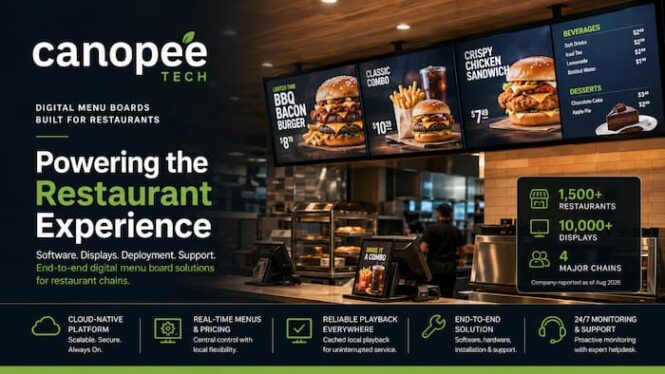
Canopee Tech is an emerging restaurant technology company built specifically around enterprise digital menu boards and digital signage for restaurant chains.
The instinct with a company this young is to file it under early-stage digital signage startups. That would be the wrong read. Founder Thibaud Denolle spent roughly 12 years at Acrelec, one of the two approved digital menu board hardware providers to McDonald’s globally, finishing as Director of Marketing and CEO of Acrelec America (Business Wire). Canopee’s product strategy therefore comes out of direct exposure to large-scale QSR deployment reality rather than out of adapting a general-purpose CMS to restaurant use.
But the more useful framing for buyers is not that Canopee is new. It is that the top of this market is not fragmented — it is already allocated by contract. Understanding what Canopee is actually competing for is the whole assessment.
The Market Canopee Is Entering
Enterprise restaurant digital menu boards look like a crowded software category from the outside. At the enterprise tier it is not crowded at all. It is three incumbents holding long-dated positions:
Coates Group was named McDonald’s single global digital menu board Content Management System provider under a five-year agreement, following a multi-round RFP, and supports approximately 50 McDonald’s markets (QSR Magazine). Its Switchboard CMS is purpose-built for QSR, and the majority of its customers are global QSR brands (Digital Signage Today).
Acrelec, founded by former McDonald’s employees, is the other approved McDonald’s DMB hardware provider (QSR Magazine) and reports more than 120,000 solution installations across 70+ markets, over 1,000 employees in 18 countries, and nearly 70 global customers including McDonald’s, Burger King, and Wendy’s (Business Wire).
Delphi Display Systems — menu boards, drive-thru timers, voice ordering, and order confirmation across 40,000+ locations in 75+ countries — was acquired by Toast, which explicitly framed the deal as adding drive-thru and digital menu boards to its offering for small and large QSRs (Orange County Business Journal).
Below that sits STRATACACHE/Scala, which has extended its menu board line into QSR automation with Quintet (Sixteen:Nine), and then a large SMB cloud-CMS tier — Yodeck, OptiSigns, Pickcel, Kitcast, NoviSign, Mandoe — where restaurants are one vertical among many (Digital Signage Today).
The consequence: Canopee is not competing for whitespace at the enterprise tier. It is competing for displacement, second-source vendor slots, and the mid-market chains the top three underserve. Every strength and risk below should be read against that.
Company Overview
Canopee Tech provides end-to-end digital menu board technology for restaurant brands, spanning software, display hardware, deployment, and ongoing field support (Canopee).
Quick facts
Item
Detail
Company
Canopee Tech Inc.
Focus
Restaurant digital menu boards and digital signage
Founder / President
Thibaud Denolle
U.S. base
Miami, Florida
Target market
QSR, fast casual, multi-location restaurant chains
Permitting, installation, commissioning, monitoring, helpdesk, field support (Canopee)
Reported deployment
1,500+ stores, 10,000+ displays, four major chains (founder-reported, August 2026)
A note on the deployment figures
Canopee’s reported milestone — 1,500+ stores and 10,000+ displays across four major global restaurant chains roughly four months after first pilot — is the single most important claim in this assessment, and it deserves a precise caveat rather than a soft one.
That figure is single-source and founder-reported. It has not been independently corroborated, no customer has confirmed it publicly, and it does not appear anywhere on Canopee’s own website, which as of this assessment carries no customer names, no deployment statistics, no leadership bios, and no stated locations (Canopee). No third-party trade coverage of the company or the milestone was located.
This is not an accusation — early-stage enterprise vendors are routinely bound by customer NDAs, and that alone explains most of the silence. But procurement and competitive analysis should treat the number as unverified until references are produced.
Leadership and Domain Credential
Denolle’s roughly 12 years at Acrelec spanned self-order kiosks, digital menu boards, drive-thru technology, and customer-experience systems. In Acrelec’s 2022 NCR Aloha integration announcement he was identified as Innovation & Marketing Director and articulated a view of digital signage extending well past menu display — dynamic pricing, product outage, indoor video walls, and personalized loyalty-enabled drive-thru journeys (PR Newswire). By Acrelec’s March 2025 rebrand he was Director of Marketing and CEO of Acrelec America (Business Wire).
That is a stronger credential than a product-marketing background: it includes P&L responsibility for the Americas business of a company with McDonald’s-scale deployments.
The credential cuts both ways, and buyers will raise it. The same background that gives Canopee its restaurant-first architecture also makes Acrelec the most probable incumbent being displaced in Canopee’s early wins. Denolle stated publicly on leaving Acrelec that he had already been working for several months on a new QSR digital menu board solution (LinkedIn). Enterprise procurement and legal teams should expect to ask about non-compete scope, IP provenance, and whether the four reported chains are existing Acrelec accounts. Raising the question openly is more credible than omitting it; a clean answer strengthens Canopee’s case rather than weakening it.
Products and Capabilities
Experience Engine — menu board software
Canopee’s stated design goal is letting restaurant marketing teams move without engineering dependency, with local freedom inside a brand frame, frictionless print-to-digital transition, and a path from fast pilot to scale (Canopee).
The central-versus-local tension is the right thing to build around. In franchise networks, corporate standards have to coexist with regional pricing, local promotions, store-level product availability, and market-specific content. Platforms that solve this cleanly win renewals; platforms that force a choice between rigid central control and ungoverned local editing lose them.
Platform foundation
Canopee describes real-time pricing and order confirmation, autoscaling infrastructure on Kubernetes and Docker, fully cached local playback, MFA, granular roles, SSO support, and SOC 2-aligned architecture (Canopee).
Fully cached local playback is the operationally significant item. A menu board that goes dark or stale when the store loses connectivity is a revenue and compliance problem, not a cosmetic one.
Hardware and deployment services
Indoor commercial LCD, digital menu board arrays, large LED walls, and outdoor hardware for harsh environments, plus permitting, installation, commissioning, monitoring, helpdesk, and field support (Canopee). This is a materially more complete model than a CMS-only vendor offers — and it is table stakes against Coates, Acrelec, and Toast/Delphi, all of which already deliver software plus hardware plus services.
1. Architecture recency is Canopee’s genuinely defensible edge. Coates, Acrelec, and Delphi platforms all carry a decade or more of accumulated deployment debt from earlier hardware generations, earlier connectivity assumptions, and earlier security expectations. A restaurant-first stack designed in 2025–26 around Kubernetes, autoscaling, cached local playback, and SOC 2-aligned design from the outset (Canopee) can plausibly beat incumbents on rollout speed and per-store deployment cost. That is precisely the claim the 1,500-store velocity figure supports, and it is why the figure matters more than its absolute size.
2. Toast is the structurally more dangerous competitor than Coates. Coates competes for the same RFPs on similar terms. Toast competes by making the menu board a near-incremental extension of a POS the restaurant already runs — which is exactly why it bought Delphi, framing the deal as enhancing its offering for small and large QSRs alike (Orange County Business Journal). Canopee has no POS. In the fast-casual and mid-market segments where Canopee’s fit is otherwise strongest, Toast can undercut on total cost of ownership simply because it already owns the menu and price data that a menu board consumes. Canopee’s answer has to be integration neutrality and demonstrably better content operations.
3. Displacement economics, not product features, will decide most deals. Ripping out an installed enterprise menu board estate means writing off hardware, retraining marketing teams, rebuilding content libraries, and re-integrating POS. Incumbency in this category is sticky for reasons that have nothing to do with software quality. Canopee’s realistic near-term paths are new-build stores, refresh cycles reaching end-of-life, chains still on static or first-generation digital, and second-source slots in dual-vendor structures — a structure McDonald’s own dual-hardware arrangement demonstrates is normal here (QSR Magazine).
Displacement vs. Greenfield: Where the Real Opportunity Is
The credible five-year Canopee thesis is not that it beats Coates at McDonald’s.
It is that a large population of tier-2 and tier-3 chains — roughly 200 to 2,000 locations — is running static or first-generation digital menu boards, is too small to command sustained attention from the global incumbents, and does not want to adopt an entire POS platform to modernize its boards. That segment has real menu complexity, real franchise governance requirements, real drive-thru needs, and genuinely poor vendor options today.
Canopee’s claimed profile maps onto that segment almost exactly: restaurant-specific logic, central-plus-local governance, indoor and outdoor coverage, and integrated deployment services from a single supplier. It is also the segment where an unproven operating history is least disqualifying, because the buyer is not betting a 40,000-store estate on the decision.
If Canopee wins there and builds a reference base, the enterprise displacement conversations become possible. In the other order, they generally do not.
Deployment Fit Analysis — TIG
Deployment type
Fit
Rationale
QSR digital menu boards
Very High
Core product and stated company specialization
Fast-casual menu boards
Very High
Strong match for multi-location menu and promotional management
Enterprise restaurant chains
Very High (product) / Moderate (procurement risk)
Architecture targets scale and governance; operating history and references remain unproven
Franchise restaurant networks
Very High
Central brand control with governed local flexibility is a stated design center
Second-source / dual-vendor deployments
High
Realistically the fastest credible path into large chains; a normal structure in this market
Mid-market chains (200–2,000 stores)
Very High
Underserved by global incumbents; Canopee’s most defensible target segment
Drive-thru menu boards
Moderate–High, pending verification
Founder background aligns closely, but outdoor is the hardest segment and no hardware specs, enclosure ratings, or display partners are published
General retail digital signage
Low
Applicable technology, but entrenched competition and no strategic reason for Canopee to contest it
Corporate digital signage
Limited
Not the company’s positioning
Small independent restaurants
Limited
Platform and services model are built for multi-location operators
Drive-thru deserves the downgrade specifically because outdoor is where this category is hardest: enclosure ratings, high-brightness and thermal management, sunlight readability, ADA and accessibility compliance, municipal permitting, and multi-year hardware SKU commitments. Founder credibility is real here — Acrelec’s outdoor drive-thru work is well documented — but Canopee has published capability claims rather than specifications.
Strengths
Restaurant-first architecture. The platform appears designed around menu operations, pricing, and franchise governance rather than adapted from general-purpose signage (Canopee).
Senior operating credential. Roughly 12 years at Acrelec finishing as CEO of Acrelec America (Business Wire) — P&L-level experience, not just product exposure.
Deployment velocity signal. If verified, moving from first pilot to 1,500+ stores and 10,000+ displays in roughly four months is meaningful evidence that the architecture has cleared pilot conditions and works at multi-thousand-endpoint scale.
Modern enterprise foundation. Cached local playback, autoscaling, SSO, MFA, granular roles, and SOC 2-aligned design (Canopee) address enterprise IT requirements that older platforms retrofitted.
Single-supplier model. Software, hardware, permitting, installation, monitoring, and field service under one contract reduces coordination burden (Canopee).
Considerations
No verified references. Four major chains reported, none named, nothing on the company website, no third-party coverage (Canopee). This is the primary procurement obstacle.
Provenance questions. Buyers should expect to raise non-compete scope, IP origin, and account provenance relative to Acrelec.
No POS of its own. Against Toast in particular, integration breadth and neutrality have to substitute for owning the data layer.
Unproven field-service footprint. Which install, service, and field-support capabilities are delivered by Canopee directly versus regional subcontractors, and in which geographies, is not disclosed.
Lifecycle commitments. Five- to seven-year platform support, hardware SKU continuity, SLA structure, and upgrade path all need contractual definition — the area where young vendors are genuinely weaker, not just perceived to be.
SOC 2 status. “SOC 2-aligned” is not SOC 2 Type II attested. Buyers with audited-security procurement standards should confirm current status and certification roadmap.
Decision Framework
Consider Canopee if:
You operate a multi-location restaurant network, particularly in the 200–2,000 store range
Menu boards are operational infrastructure, not advertising displays
You need centralized brand governance with governed local flexibility
Menus involve complex pricing, dayparting, or regional variation
You need indoor and outdoor coverage from one supplier
You are dissatisfied with incumbent responsiveness and open to a second source
You are refreshing an end-of-life estate or building new stores, rather than ripping out recent hardware
Compare carefully if:
Your procurement standards require decades of operating history or audited certifications
You need substantial non-restaurant deployment evidence
You require guaranteed long-term hardware SKUs and contractual lifecycle commitments
You already run a mature enterprise CMS and need only displays or players
You are a Toast POS customer, where the bundled economics need direct comparison
You need dense global field-service coverage across many countries today
Where Buyers Should Investigate Further
Named customer references and permission to contact them; POS and menu-data integrations; dynamic pricing and product-availability behavior; outdoor display specifications, enclosure ratings, and hardware partners; media-player architecture and device management; monitoring and remote diagnostics; SLA and uptime commitments with remedies; geographic field-service coverage and subcontractor structure; SOC 2 status and roadmap; hardware lifecycle and SKU continuity commitments; accessibility and ADA capability; five- to seven-year platform support strategy; and non-compete and IP provenance confirmation.
TIG Perspective
Canopee Tech is unusual among new restaurant technology companies because the company is young and the domain expertise is not. That distinction is real and it justifies attention.
But the useful analytical point is about market structure rather than pedigree. The enterprise digital menu board tier is not an open field — it is held by Coates at McDonald’s under a five-year global CMS agreement, by Acrelec across 120,000-plus installations, and increasingly by Toast bundling Delphi’s menu board and drive-thru technology into a POS platform restaurants already run. A new entrant does not win that tier by being better. It wins by finding the segment the incumbents structurally cannot serve well, proving itself there, and building reference credibility it can carry upmarket.
That segment exists, it is large, and Canopee’s stated design appears aimed at it. The 1,500-store figure, if it holds up, suggests the company already knows this. What is missing is the external verification that turns a founder’s claim into a procurement-grade reference — and until that arrives, Canopee belongs firmly on the watch list rather than the shortlist for a bet-the-estate rollout.
For chains running a refresh cycle, opening new stores, or looking for a credible second source, it belongs on the RFP list now.
FAQ
What is Canopee Tech?
A restaurant technology company specializing in enterprise digital menu boards and digital signage for restaurant chains, spanning software, display hardware, installation, commissioning, monitoring, and ongoing support (Canopee).
Who founded Canopee Tech?
Thibaud Denolle, who spent approximately 12 years at Acrelec and served as Director of Marketing and CEO of Acrelec America (Business Wire).
How many restaurants use Canopee technology?
As of August 2026 the company reported 1,500-plus locations and 10,000-plus displays across four major chains. These are founder-reported figures that have not been independently verified and do not appear on the company’s website (Canopee).
Which competitor is the biggest threat to Canopee?
Arguably Toast rather than Coates. Toast can bundle menu boards with a POS that already holds the restaurant’s menu and pricing data, which changes the cost comparison in exactly the mid-market and fast-casual segments Canopee targets (Orange County Business Journal).
Is Canopee primarily a digital signage CMS?
No. It positions as an end-to-end restaurant menu board provider spanning software, infrastructure, displays, deployment, and support (Canopee).
Does Canopee provide outdoor digital menu boards?
The company states it supports outdoor hardware built for harsh environments alongside indoor LCD and LED walls (Canopee). Specifications, enclosure ratings, and hardware partners are not published, so drive-thru buyers should verify directly.
Does Canopee support installation and field service?
Yes — permitting, installation, commissioning, helpdesk, monitoring, and field support are listed as part of the offering (Canopee). Buyers should confirm which are delivered directly versus through regional partners.
Is Canopee SOC 2 certified?
The company describes SOC 2-aligned architecture (Canopee), which is not the same as SOC 2 Type II attestation. Confirm current status and roadmap during procurement.
What should enterprise buyers verify first?
Named customer references with contact permission, POS and menu-data integrations, outdoor hardware specifications, SLA remedies, geographic field-service coverage, SOC 2 status, and multi-year hardware lifecycle commitments.
Notes
Samsung — probably the clearest restaurant/QSR story
Samsung explicitly markets a fairly complete QSR display ecosystem: indoor digital menu boards, exterior menu boards, high-brightness/outdoor products, order-status boards and VXT CMS. Its commercial screens also increasingly incorporate the media-player/OS functionality that previously required separate players.
So I wouldn’t describe Samsung merely as a screen manufacturer. In menu boards, it can occupy hardware + player/platform + device management + CMS.
LG — very similar position
LG is also explicitly pursuing restaurants and QSR. Its portfolio covers indoor DMBs, outdoor/drive-thru signage, window-facing displays, LED, kiosks, webOS and SuperSign CMS. LG specifically promotes centralized menu and price changes and commercial displays designed for 18–24/7 operation.
About the Editor
Craig Allen Keefner is an industry analyst and editor covering digital signage, self-service technology, interactive displays, and restaurant technology. He is the publisher of Digital Signage Blog and executive director of the Kiosk Manufacturer Association, with decades of experience tracking the technologies and companies shaping customer-facing digital systems.
Deployment figures attributed to Canopee Tech are company- and founder-reported as of August 2026 and should be independently confirmed for procurement or competitive analysis.
Nobody Wrote a Standard for the AI in Your Drive-Thru. Europe Wrote Most of One. And what about Vending and other verticals like Lockers, POS, EV Charging, etc. They all orbit our Accessibility Sun. https://kioskindustry.org/drive-thru-ai-regulations/
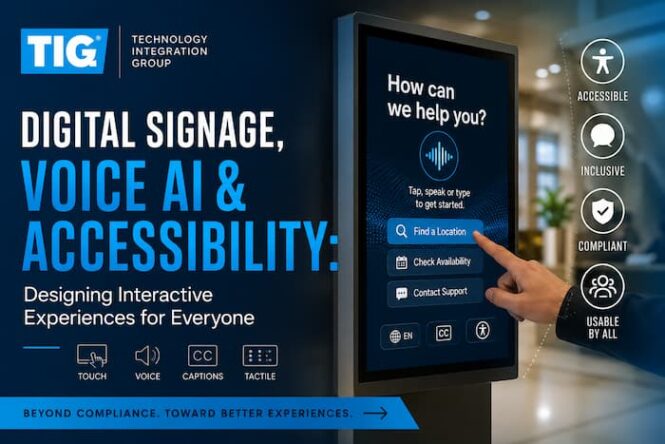
Digital Signage, Voice AI and Accessibility: When a Screen Becomes an Interface
Digital signage is rapidly evolving beyond passive displays. Touchscreens, interactive directories, AI assistants, voice interfaces and transactional displays increasingly blur the line between traditional signage and self-service kiosks.
That distinction matters for accessibility.
A recent Kiosk Industry analysis of voice AI and self-service accessibility regulations highlights an important regulatory gap: U.S. accessibility rules often depend less on what a device looks like than on what the customer is expected to do with it.
Passive Versus Interactive Digital Signage
Traditional non-interactive digital signage remains relatively lightly regulated in the United States. Digital menu boards and building directories, for example, can fall outside portions of ADA signage scoping.
Once the display becomes interactive, however, the situation changes.
A touchscreen directory, wayfinding display, ordering screen or conversational AI interface may require the customer to navigate information, make selections or complete a transaction. Yet current U.S. accessibility standards do not provide one comprehensive technical standard covering all of these devices.
That leaves an important gap between minimum regulatory requirements and genuinely accessible design.
Section 508 Provides a Useful Baseline
Federal Section 508 requirements provide one of the most useful existing technical references for electronic displays.
Among the requirements applicable to federal ICT are specifications addressing variable-message-sign legibility, character presentation, contrast, speech output and tactile controls.
For commercial digital signage operators that may not technically fall under Section 508, these requirements can still provide a practical design baseline.
The Kiosk Industry analysis recommends using the Section 508 reference to ICC A117.1 variable-message-sign requirements as a house standard for electronic display legibility.
Voice AI Creates Another Accessibility Layer
Conversational AI introduces a different set of issues.
The fundamental principle should be simple:
Voice should never be the only way to complete a transaction or access essential information.
Speech recognition can perform very differently for people with stutters, dysarthric speech or other speech disabilities. Deaf and hard-of-hearing users face an even more fundamental problem with voice-only systems.
An accessible conversational interface should therefore provide another path, such as touchscreen or text interaction, along with visual confirmation of what the AI understood and a way to reach human assistance without first having to successfully communicate with the voice system.
Europe Is Further Ahead
The regulatory landscape is clearer in Europe.
The European Accessibility Act has applied to covered products and services since June 28, 2025, while EN 301 549 provides detailed ICT accessibility requirements. Significantly for AI deployments, EN 301 549 includes requirements for alternatives to voice-based services.
For multinational digital signage and self-service suppliers, this creates an interesting situation: accessibility capabilities required or supported for European deployments may already exist even when equivalent U.S. regulations have not yet caught up.
Interactive Signage Should Be Treated Differently
The practical takeaway for the digital signage industry is to stop treating every screen as the same product category.
A passive advertising display is one thing.
An interactive directory, touchscreen menu, wayfinding kiosk, AI concierge or conversational display is another.
Once the customer must interact with the screen to obtain information or complete a task, designers should consider accessibility requirements involving screen readability, reach, alternative input, speech output, captions, tactile controls and non-voice alternatives.
The safest approach is also the simplest: design interactive signage for independent use rather than designing only to the minimum regulatory requirement.
As displays become intelligent interfaces, accessibility becomes part of the user experience—not simply a kiosk compliance issue.
Adapted from the Kiosk Industry analysis “Nobody Wrote a Standard for the AI in Your Drive-Thru,” which examines U.S., European and Canadian accessibility requirements for voice AI, kiosks, digital signage, vending, lockers, smart-city displays and EV charging.
Every year, the invidis Yearbook serves as the “bible of the industry” — and reading the 2024 and 2026 editions back to back reveals a market that has fundamentally changed character. In 2024, invidis titled its yearbook “Signage & Software,” arguing that the platform layer had become where the value lives. Two years later, the 2026 editions carry a heavier message: “NextGen Signage,” an industry now operating under what the editors call permanent disruption.
Here is what the three most recent yearbooks (2024 Global, 2026 Global, and the 2026 Americas edition) tell us about where digital signage — and the self-service technology that rides on it — is heading.
What invidis says — from “nice-to-have” to business-critical infrastructure
The single biggest shift is one of status. After 25-plus years, digital signage has stopped being a discretionary marketing gadget and become business-critical infrastructure. National players are merging into global groups, enterprise IT is taking the lead, and — as invidis puts it — scalability, resilience, and governance now matter as much as creativity and content.
That maturation comes with a cost. The 2026 editions describe a “polycrisis”: overlapping shocks from geopolitics, energy markets, tariffs, and technology that no longer act independently but amplify each other. The comfortable era of stable hardware pricing and predictable rollouts is over. In its place: a market that finally plays by normal enterprise-IT rules.
Three themes define the moment.
Theme 1 — The power shift from hardware to software and services
In 2024, invidis noted that roughly every second digital-signage euro was already being spent outside of hardware, as CMS platforms evolved from siloed apps into open, data-driven systems. By 2026, that shift has accelerated into a full-blown realignment.
The market is moving from ProAV specialists toward global IT managed-service providers — players with scale, balance sheets, procurement power, and industrialized rollout capabilities. Managed services invert the old logic: instead of buying and operating their own screens, customers increasingly buy uptime and outcomes, with hardware staying on the provider’s books as a 5-to-10-year service asset.
In QSR and hospitality, this is already the norm — menu boards and order kiosks are sold inside broader POS platforms and bundled into monthly subscriptions. As invidis frames it, the customer no longer buys “a signage network”; they buy “a functioning restaurant system.” The market isn’t consolidating around fewer brands, but around fewer points of accountability. Whoever owns the relationship, the data, and the operational responsibility captures the margin.
Theme 2 — AI as the NextGen catalyst
In the 2024 yearbook, AI was “omnipresent” at ISE, but mostly as a quiet enabler: fault detection, brightness optimization, GenAI content creation and auto-translation. By 2026, the story has matured into the transition “from digitalization to automation — and increasingly to autonomy.”
AI now powers the NextGen CMS, drives edge analytics through NPUs built into SoC displays, and enables “screens that think.” But the same forces cut both ways. AI has become a threat multiplier for attackers — faster, cheaper, and hyper-personalized — forcing the industry to shorten security patch cycles from years to months. invidis argues signage is more resilient than horizontal SaaS thanks to deep data integration, hardware diversity, and high switching costs, and that endpoint-based and headless/API-consumption pricing models are the most future-proof.
Theme 3 — Resilience, sovereignty, and security as buying criteria
This is the most dramatic change from 2024. The 2026 editions describe an AI-driven memory price shock — RAM, SSD, and even SD-card prices up four-to-five times, with entry-level media players in some cases doubling — pushing the industry toward Android and lean Linux (Yocto/ARM) and away from embedded Windows.
Meanwhile, “origin starts to matter.” China now controls the industry’s critical manufacturing choke-points (LCD cells and DV-LED), and buyers increasingly ask not just where hardware is made but where software is developed and governed. Digital sovereignty — long a cloud concern — now extends to end-to-end signage ecosystems. US-based and vertically integrated players like Daktronics and Stratacache are cited as accountability benchmarks.
Security has become table stakes. invidis prescribes compliance from the start (ISO 27001), continuous testing, and managed-service contracts to fix the weak accountability of unmaintained on-prem systems. Robust security, the editors say, is no longer a differentiator — it’s a minimum requirement.
What we watch — the technology topics worth watching
Interactive & touchless: Gesture control (Ameria, integrated with Sony/Samsung spatial displays) and 3D-effect displays paired with AI avatars are the new interactive frontier — especially for hygiene-sensitive and premium retail settings.
Menu boards & QSR: Increasingly absorbed into POS-driven OpEx subscription models — scalable and margin-stable, but a disintermediation risk for standalone signage vendors.
Transparent / digital-on-glass: A “slow bloom.” LED-film and mesh solutions are lowering the cost barrier for window LED, though Omdia still sizes the category modestly (~$100M by 2032).
E-paper: The clearest low-power niche, competing with printed posters rather than LCD/LED. E Ink dominates (Spectra 6 indoor, Marquee outdoor); ESL players like Vusiongroup and Solum are extending into larger formats. Cost remains the main barrier.
Outdoor & DOOH: Now a strategic, programmatic, retail-media-driven asset — JCDecaux as “the savior,” airports as the “luxury tier,” and higher-brightness semi-outdoor LCD (Hisense at ~4,000 nits).
Regulatory & risk: EU sustainability mandates (CSRD, Ecodesign, digital product passport), cybersecurity ownership — and, new in 2026, a wave of patent litigation from Alpha Modus targeting Cooler Screens, Creative Realities, and Mood Media by claiming the “connective tissue” of physical-retail engagement.
What it means for integrators and self-service
For North American integrators and the self-service/kiosk community, the takeaways are concrete: reposition around outcomes and managed services, treat security compliance as a sales differentiator, lean into retail-media monetization, and explore emerging niches like e-paper, touchless kiosks, and window LED. The active risks to watch are tariff and supply volatility, cyber exposure on unmaintained deployments, and the very real patent-litigation threat now hitting US retail-tech.
The era of predictable growth narratives is over. As invidis concludes: resilience, not optimism, will separate the winners from the rest.
Addendums — Our Take
The regulatory gap: accessibility
One thing the invidis Yearbooks essentially don’t cover is the EAA. Across all three books, there’s no dedicated treatment of the European Accessibility Act, ADA, WCAG, or EN 301 549. The only accessibility touchpoint is a single passing example in the 2026 editions: a “Silvia” sign-language digital human that supports hearing-impaired transit passengers, mentioned under “inclusive design” in a Touch Taiwan feature. The yearbooks’ regulatory focus is squarely on sustainability (CSRD, Ecodesign, product passport), cybersecurity/ISO 27001, supply-chain sovereignty, and patent litigation — not accessibility.
That’s actually a notable editorial gap. The European Accessibility Act (Directive 2019/882) became directly enforceable across all 27 EU member states on June 28, 2025, and it explicitly lists self-service terminals as a regulated product category.
What’s covered: ATMs, ticketing machines, check-in kiosks, payment/POS terminals, and information kiosks tied to a covered service (banking, e-commerce, transport, telecoms) (Accessible.org).
Who’s on the hook: Manufacturers, importers, distributors, and the service operators that deploy the terminals (Accessible.org).
The standard: EN 301 549, mapped to Annex I functional requirements — output through more than one sensory channel (visual + audio), text-to-speech with a headphone jack for private listening, adjustable text size/contrast/timing, tactile buttons and alternative input modes, plus CE marking, an EU Declaration of Conformity, and a technical file (Acquia, solidwaretools).
Teeth: Penalties vary by member state — in Germany the BFSG allows fines up to €100,000 per violation (solidwaretools).
Key dates: Only terminals first placed on the EU market after June 28, 2025 must be verified; pre-existing units can keep circulating. Certain self-service terminals get an extended transition to June 28, 2030 (Acquia, Accessible.org).
Geography — the global power shift
This is a major thread in the 2026 editions. The 2026 books frame the global market through a “Zeitenwende/polycrisis” lens, and China’s ascendancy is the central storyline. Here’s how it breaks down by region.
China — structural, not cyclical, dominance
Within just 12–18 months, the global balance of power in display manufacturing shifted decisively to China. The symbolism was TCL taking a majority stake in Sony’s Bravia B2B display business, and Skyworth taking over Panasonic’s consumer display unit. TCL, Hisense, and BOE now control the industry’s critical choke-points — LCD-cell manufacturing and DV-LED production — enabling aggressive pricing and unmatched time-to-market. With domestic Chinese demand still subdued, export markets have become “strategically existential.” invidis is explicit that this dominance is now structural, not cyclical — US restrictions on AI tooling and semiconductors may delay but won’t reverse the trajectory. China has also formally defined digital signage as a strategic technology sector (dual civil/military relevance).
(Our own observation: in the interactive world we see NCR and Fujitsu offloading/relocating hardware to Asia as further evidence of the same gravitational pull.)
The regional split — premium vs. volume
The yearbooks draw a clear line:
Chinese manufacturers dominate SMB/long-tail deployments in Africa, APAC, and Latin America.
Premium segments in Europe, North America, and Japan remain led by Korean and Japanese brands — Samsung has held the global commercial-display lead for 17 consecutive years — but competitive pressure is rising even in the premium tier.
Europe (EMEA) — resilient but flat, and an oversupply dumping ground
EMEA grew modestly (~+2% value) while the global market contracted ~1.5% to €20.6bn in 2025. LED sales in EMEA nearly doubled 2022–2025, but the region is still only ~14% of global LED volume. A notable dynamic: to dodge US tariffs, manufacturers diverted a massive influx of LCD/LED hardware into Europe, far exceeding organic demand — compressing margins and driving crisis-driven price erosion. Europe is also leading the sovereignty / “origin matters” push.
United States / North America — resilient economy, lagging signage
The Americas edition’s North America ranking is titled “Tariffs and Tech Tailwinds.” US GDP is projected at a solid 2.1–2.3% for 2026, but digital signage expands only ~1–2% — because the growth is being carried by AI-infrastructure capex (data centers) that’s largely decoupled from signage. Tariffs cast a long shadow: importers absorbed costs, margins compressed, and the lack of long-term planning visibility still weighs on large hardware rollouts. Two structural notes: the market is dominated by large multi-IT/ProAV integrators, and the Stratacache financial restructuring (a top-4 NA player) is triggering client migrations and a rare share-redistribution moment (Scala sold to Vertiseit). Some US customers now even question “Made in USA” for certain categories amid strained allied relations — the goal being diversification, not substitution.
LATAM — the greenfield growth story
The LATAM ranking is titled “Growth and New Structures.” LATAM GDP is projected at ~+2.3% in 2026, and it’s described as “one of the last major regions with significant greenfield potential” — large parts still underserved. Country detail: Brazil (largest economy, stabilizing), Mexico (largest DS market in LATAM, heavy international-player presence via US integration/USMCA), Andean markets (Chile/Peru, commodity-driven), and Argentina as a reform-driven upside surprise. Competitively: regional integrators (Enmedio, SIA Interactive, Onsign, Eletromidia/4yousee) expand on local relationships; NA/European specialists target enterprise and premium retail; and Chinese vendors dominate the hardware side. LATAM integrators still rely heavily on international CMS.
Ascendancy ranking
Manufacturing/hardware supremacy: China, decisively and structurally — dominant in SMB globally and on hardware in LATAM/APAC/Africa.
Premium brand hold: Korea/Japan (Samsung, LG) in Europe/NA/Japan, but under pressure.
Fastest growth potential: LATAM (greenfield) — but Chinese hardware-led.
Resilient but flat: Europe (~+2%, oversupplied by tariff diversion) and the US (~1–2%, decoupled from the AI capex boom).
The invidis position — how the Yearbook compares to other research
invidis isn’t really competing with the report mills. It sits on top of Futuresource data (its supplier) and Omdia (frequently cited) and adds editorial judgment, CMS rankings, and integrator interviews.
invidis is a specialist consultancy/publisher that turns data into narrative — and it sources its LCD/LED numbers from Futuresource (its data supplier) and frequently cites Omdia (panel shipments, the Samsung ranking).
A second tier of syndicated report mills — Grand View Research, Global Market Insights, Market Research Future — is only good for a headline TAM, and their wide spread (~$30B to ~$62B by the mid-2030s) is the reason not to trust any single one.
What makes the yearbook distinct is its editorial layer: CMS rankings, integrator interviews, and the new NA/LATAM editions.
Bottom line — niche and flat, or quietly compounding?
A fair question we hear a lot: digital signage has seemed fairly niche and somewhat flat since the pandemic. Is that accurate, and where is it headed? The short version: that instinct is only half right.
It was never truly flat — it was quietly compounding. After the 2020 collapse and a strong 2022 rebound, 2023–2024 were genuinely tough on macro headwinds (Futuresource). But underneath, the market kept growing — from roughly $19.6B in 2021 to ~$29–31B in 2025, about a 7–8% CAGR (Grand View Research). It only looked flat because signage revenue is buried inside IT, AV, POS, and retail-media budgets — it’s becoming infrastructure, not a standalone product line.
Right now it’s actually outperforming. Omdia’s Q1 2026 data shows signage/information displays posted their third consecutive quarter of growth (+4.3% QoQ, +2.8% YoY at 1.61M units) while the broader ProAV/display market declined — videowalls fell ~19% YoY and Omdia downgraded the overall 2026 display market to a ~6% unit decline (invidis / Omdia).
Where it’s headed: steady mid-to-high single-digit growth, roughly doubling over a decade — global market to ~$52–62B by the mid-2030s at ~7.6–8.6% CAGR (Grand View Research, Global Market Insights). The US alone runs ~$7.4B (2025) toward ~$13B by 2033, with kiosks the single largest segment (~24.6% share) (Grand View US). The four structural drivers: retail media / programmatic DOOH, LED overtaking LCD in value, self-service / QSR, and a regional shift toward Asia-Pacific and greenfield LATAM. The character is changing more than the trajectory — from a hardware product to a services-and-media platform, with self-service and retail media as the two fastest-growing engines.
Comments from Craig
Digital signage still hasn’t cracked ROI — no closer than a decade ago.
AI is real on the backend, but customer-facing “interaction” is still mostly smoke and mirrors — little actually deployed.
Source: invidis Yearbook 2024 (Global) and invidis Yearbook 2026 (Global & Americas editions), “NextGen Signage.” Certain 2026 macro details in the yearbooks read as invidis’s forward-looking scenario analysis rather than confirmed external fact. Market-size and shipment figures in the “Bottom line” section are from Futuresource, Omdia, Grand View Research, and Global Market Insights as linked. Accessibility/EAA details are sourced externally as linked, not from the yearbooks.
Insight Touch touchscreens. 10″ to 65″ PCAP. Customized.
We also recommend Keyser in Chicago
Digital Signage Market Research 2024
According to various sources, the digital signage market size is estimated to be between USD 25.52 billion and USD 42.54 billion in 2024, and is expected to grow at a CAGR of 7.7% to 8.4% from 2024 to 203012345. The market is driven by factors such as the increasing demand for enhanced customer experience, the rising adoption of innovative display technologies, and the growing use of digital signage in various industries and settings12345. However, the market also faces some challenges, such as the high initial investment and maintenance costs, the regulatory and environmental issues, and the competition from online advertising and other media channels12345.
China is rapidly becoming one of the highest-density digital signage markets in the world—not just in scale, but in how deeply screens are embedded into everyday urban life. From Kioskasia.org
Craig Allen Keefner comment — “As someone who’s watched the kiosk and digital signage market from both the US and Shenzhen, I think this piece captures a key point: in China, screens aren’t just ‘displays’—they’re infrastructure. Government‑backed urban projects, dominant domestic panel manufacturing, and fast procurement cycles mean DOOH and retail signage can scale at a speed Western integrators still find hard to match. The next competitive battleground is less about hardware price and more about software, data rights, and who controls the monetization layer on top of these nationwide screen networks.”
A Country Built on Screens
Walk through any major Chinese city and the pattern is unmistakable:
Restaurants replacing static menus with digital displays
This is not just adoption—it is saturation. China is no longer experimenting with digital signage; it is operationalizing it at national scale.
From Hardware to Infrastructure: The Rise of the Screen Economy
The global digital signage market reflects this transformation. Valued at $31.09 billion in 2025, it is projected to reach $58.42 billion by 2033, growing at a CAGR of 8.2%.
While North America currently holds the largest revenue share (35.6%), Asia-Pacific is the fastest-growing region, with China at its core. Grandview
What differentiates China is not just demand—but deployment logic:
Screens are treated as infrastructure, not marketing tools
Hardware (59% of market share) is tightly integrated with software ecosystems
Media players and mini PCs are deployed at scale for centralized control
This creates a network effect: the more screens installed, the more valuable the network becomes.
Why China Leads: Four Structural Drivers
1. High-Density Urban Environments
China’s megacities—Shanghai, Shenzhen, Beijing—provide the ideal conditions for digital signage:
In these environments, screens outperform static advertising by delivering dynamic, real-time content to millions daily.
2. Retail Digitization at Scale
Retail is the largest application segment globally—and China is pushing it further.
Digital signage in retail can increase foot traffic by up to 24% [Rise], particularly when multiple screens are deployed. Chinese retailers leverage this through:
Real-time promotions
Interactive kiosks (32–52 inch segment dominance)
Integrated online–offline campaigns
This aligns with China’s broader “New Retail” strategy—where physical stores act as data-driven media environments.
3. Government & Infrastructure Integration
Unlike fragmented Western markets, China benefits from top-down digital infrastructure planning.
Initiatives such as the Digital Silk Road extend beyond connectivity—they enable:
Smart city deployments
Public information systems
Transportation-based signage networks
Subways, stations, and airports rely heavily on video walls (25.5% market share) for:
Real-time scheduling
Emergency communication
Passenger navigation
In cities like Tokyo this is already critical—but China is scaling it faster and broader.
This retail TouchPoints article, written by Matt Ater of Vispero, argues that the retail industry has reached a “mission-critical” tipping point where self-serrvice technology must evolve from simple touchscreens tomultimodal, accessible interfacesthat work for everyone, regardless of physical ability or environmental circumstances. We agree. See The New Modality Stack: How Interactive Systems Are Moving Beyond the Touchscreen —
Here is summary of Matt’s article with checklist
1. The Ubiquity of the “Invisible Kiosk”
Self-service is no longer just a checkout lane; it includes pharmacy photo stations, hotel check-in screens, digital lockers, and even handheld payment devices. The common thread is that shoppers are expected to perform tasks independently and under time pressure, often without access to their own personal assistive tech (like screen readers).
2. The Problem with “Default” Design
Most systems are designed for a “standard” user who can see, hear, and stand easily. This excludes:
Situational Hurdles: Glare on screens, loud background noise, language barriers, or even a parent holding a crying child.
3. The Multimodal Solution
The goal is Choice. Multimodal systems offer various ways to interact:
Audio output via headphones.
Tactile input (physical buttons/keypads).
Voice guidance and adaptive interfaces.
4. The Business Case (Beyond Compliance)
While regulations (especially in Europe) are tightening, Matt argues that inclusion is a competitive advantage:
Operational Efficiency: Accessible kiosks prevent “friction points” where staff must leave their posts to help frustrated customers.
Consumer Trust: Privacy in payments (like entering a PIN or choosing a tip via audio) provides dignity, which builds brand loyalty.
The Bottom Line: If a system is unusable, customers leave and often don’t return.
Key Insights & Analysis
1. Accessibility as “Universal Design”
One of the strongest insights here is the shift from seeing accessibility as a “niche” feature to seeing it as robust UX (User Experience). Just as “curb cuts” on sidewalks help people with strollers and bikes as much as wheelchair users, multimodal kiosks help the person in a noisy, crowded store just as much as someone with a hearing impairment.
2. The Danger of “Checkbox” Accessibility
Ater points out a significant “fail” in current tech: hardware that looks accessible but isn’t. A headphone jack that isn’t software-enabled is a “broken promise” that frustrates users more than having no jack at all. For retailers, this means the software layer is now just as important as the physical kiosk.
3. Privacy = Dignity
In a world of increasing data sensitivity, the “payment” aspect is crucial. For a blind or low-vision shopper, having to dictate a PIN or a tip amount to a stranger is a breach of privacy. Moving toward private audio interfaces isn’t just a technical fix; it’s an ethical one that respects the customer’s autonomy.
4. The Future is “Invisible”
Matt suggests that in five years, the best self-service will “fade into the background.” This implies a move toward Ambient Intelligence —systems that recognize user needs and adapt instantly without the user having to hunt for an “accessibility mode” button.
Insight Note: This article highlights a shift in retail philosophy. We are moving away from “How can we automate this to save money?” toward “How can we automate this without losing customers?”
The Multimodal Self-Service Checklist
1. Visual & Physical Accessibility
[ ] Screen Clarity: Is the interface high-contrast? Does it remain readable under harsh overhead retail lighting or near windows (glare-resistant)?
[ ] Reachable Design: Are all interactive elements (touchscreens, card slots, receipt printers) within the ADA-mandated reach range for a person using a wheelchair?
[ ] No “Visual-Only” Cues: Does the system avoid relying solely on color (e.g., “Press the green button”) to convey meaning?
2. Audio & Speech Integration
[ ] Functional Headphone Jack: Is there a standard 3.5mm jack? More importantly, does plugging in headphones automatically trigger a screen-reading voice-over?
[ ] Volume Control: Can the user easily adjust the volume to overcome ambient store noise?
[ ] Private Audio for Sensitive Data: Can a user hear their transaction total, tip options, and PIN prompts privately through headphones?
[ ] Speech-to-Text/Voice Command: Does the system allow for basic voice navigation in quiet or semi-private environments?
3. Tactile & Input Feedback
[ ] Physical Keypad/Nav: Is there a tactile peripheral (like a Braille-labeled keypad) for users who cannot use a flat touchscreen?
[ ] Haptic/Audio Confirmation: Does the system provide a “beep” or a haptic vibration to confirm a successful scan or button press?
[ ] Timeout Alerts: Does the system provide an audio warning before a session “times out” due to inactivity, giving the user a chance to ask for more time?
4. Software & Interface Logic
[ ] Language Choice: Are the accessibility features available in all supported languages, or just the default?
[ ] Simplification Mode: Is there an option for a “high-contrast” or “large-text” mode that simplifies the UI for users with cognitive or visual impairments?
[ ] Real-Time Error Correction: If an item is scanned twice or a weight error occurs on the scale, does the system explain the error via audio?
5. Operational Support
[ ] Staff Alert Integration: If a user is struggling, does the system notify a staff member discreetly so they can provide help without the customer having to wave them down?
[ ] “Assist” Mode: Can a staff member take over the screen remotely or via a secondary interface to help clear a block without the user losing their privacy?
Pro-Tip for Implementation
The “Lab vs.Reality” Test: Don’t test this in a quiet office. Test it in a store at 5:00 PM on a Friday with music playing, carts rattling, and a line of people waiting. If a user can’t complete a transaction independently in that environment, the accessibility features aren’t fully functional yet.
HIMSS Intersection
Section 1557: The Compliance “Teeth”
The HHS finalized a rule in May 2024 that explicitly includes self-service kiosks under Section 1557 of the Affordable Care Act.
The Deadline: Large healthcare providers (15+ employees) must ensure their kiosks are accessible by May 11, 2026.
The Standard: The rule adopts WCAG 2.1 Level AA as the technical standard. This means if your kiosk is used for check-in or payment, it must support the multimodal features Ater mentioned (screen readers, tactile input, etc.).
The Risk: Unlike retail, where the cost is “lost sales,” in healthcare, non-compliance can lead to the loss of federal funding (Medicare/Medicaid) and significant civil rights litigation.
ater-comparison
2. Revenue Cycle “Shift Left”
“Shift Left” refers to moving administrative and financial tasks (insurance verification, co-pay collection) to the very beginning of the patient journey—ideally at the kiosk during check-in—rather than “chasing” the money weeks later.
How Accessibility Enables “Shift Left”
If your kiosk isn’t multimodal/accessible, your “Shift Left” strategy will fail for 20-25% of the population.
Data Integrity: A patient with a visual impairment cannot verify if their insurance info is correct on an inaccessible screen. This leads to “snowball errors” and claim denials downstream.
Upfront Collection: If a patient cannot privately and independently pay their co-pay at the kiosk (due to a lack of audio guidance for the keypad), they will skip the step. This forces the “Shift Right”—back into the expensive, manual billing cycle.
Operational Throughput: When a kiosk fails a disabled patient, they must go to the front desk. This creates a bottleneck exactly where “Shift Left” was supposed to save labor costs.
3. The “Dignity” Factor in Healthcare
In retail, Ater notes that privacy is about “dignity.” In healthcare, it is also about HIPAA.
Multimodal = Private: A blind patient shouldn’t have to shout their birthdate, address, or “reason for visit” to a front-desk clerk because the kiosk didn’t have a headphone jack.
Autonomy: Providing an accessible kiosk allows patients to manage their insurance and payments with the same independence as everyone else, fulfilling the “nondiscrimination” spirit of Section 1557.
Insight for HIMSS 2026
“Don’t just comply with Section 1557 to avoid a lawsuit; do it to protect your revenue.If your kiosks aren’t accessible, you can’t ‘Shift Left’ for every patient, and your RCM (Revenue Cycle Management) will continue to leak money on the back end.”.
Just read ISE review by Sixteen-Nine. It’s a terrific piece by Dave Haynes—classic “ISE field report” style: conversational, first-hand, and full of grounded industry insight rather than flashy hype. He does a great job balancing humor, personal anecdotes, and technical analysis.
Here are a few key takeaways and impressions from the article:
Big Picture: Haynes emphasizes that Integrated Systems Europe 2026 has now fully matured—not just in size (92,000+ attendees!) but in smooth operations. His early skepticism about four days being too long has turned into admiration for how well-organized and globally attended the event has become.
Incremental Progress, Not Big Bang: He hammers home the theme that the professional AV and digital signage industries rarely see radical yearly leaps. The improvements are incremental—better LED displays, more refined manufacturing, lower energy use—not revolutionary tech shifts. That theme aligns with a maturing industry.
AI: Promising but Uneven: Haynes notes AI was everywhere but not oversold. Many demos were superficial, but there were some strong standouts—like NetSpeek’s agentic AI for monitoring networks and ScreenCloud’s thoughtful AI direction. His metaphor comparing AI to the “engine under the hood” of a modern car was a sharp way to explain the hidden but critical role AI is starting to play.
Displays and Power Efficiency: The visual technologies—LED totems, color e-paper, mesh LEDs—show the industry’s blend of aesthetics and practicality. Energy consumption and sustainability are clearly big themes, especially with companies like Media Resources pushing reduced power draw.
Tone and Style: Haynes keeps it witty and self-aware—joking about cava-filled evenings, losing his voice, and “good luck” to Samsung selling $20K holographic signage. It feels like a seasoned insider’s voice who’s seen the cycles of hype and knows what’s truly practical.
If you step back, the article’s broader message seems to be: pro AV and digital signage are now in an era of refinement, not discovery—and AI is the next invisible layer that will quietly reshape how everything operates.
What “interactive” looks like at ISE now
Touch-first, but not touch-only
PCAP touchscreens, touch foils, kiosks, and touch video walls are still everywhere (Displax, Elo, Prestop, DTEN, etc.).
Interactive kiosks are now tightly tied to workplace, wayfinding, check-in, and self-service workflows rather than just “cool demos.”
Other interaction modes layered on
Cameras and sensors (for people counting, audience analytics, sometimes simple gesture triggers) are used alongside touch—less flashy “Minority Report” waving, more subtle sensing.
Voice is emerging in noisy‑environment‑ready hardware (like the voice‑AI speaker Haynes mentioned), though it is still a niche and usually paired with a screen rather than replacing it.
Mobile is part of the interaction mix: scan a QR, tap NFC, or use an app to drive the content on a larger shared display instead of everyone touching the screen.
Executive Takeway
Clarify your lane
“We’re the best generic CMS” is a weak story now. A stronger story: “We’re the easiest way for X-type business to do Y outcome” (e.g., grocery chains managing 10,000 shelf labels and 500 menu boards).
Build or adopt AI where it matters
Content and layout co‑pilot for non-technical staff.
Automated NOC / monitoring and remediation.
Lightweight micro‑apps that sit on top of BrightSign / VXT / LG / Google TV stacks.
De-emphasize features, emphasize lifecycle
Energy costs, uptime, remote management, and ease of change are what owners will care about through the next cycle more than one more transition effect or exotic display format.
Pro Tip — Organizations that treat design as appearance often revisit it through unplanned service costs, compliance exposure, and shortened hardware lifecycles. Those that treat design as a system—balancing brand, usability, and serviceability—build platforms that scale, endure, and deliver ROI long after deployment.
Before approving a kiosk design, leadership should ask not how it looks on day one, but how it performs in year three. From recent kiosk industry article.
Current direction of interactive
From gadget to workflow tool
New interactive workplace kiosks (DTEN + Appspace with Microsoft Places) show the emphasis on space booking, visitor check-in, and workplace analytics rather than pure signage.
Industrial and control-room touch solutions focus on reliability and ergonomics for operators, replacing buttons/knobs and tying into data dashboards.
Why touch still dominates
It’s intuitive and cheap. Easy to support at scale; most alternatives (full-gesture, pure voice) stumble on reliability, learning curve, or cost.
“Touch + something” (touch + sensors, touch + voice, touch + mobile) is where most serious deployments are going rather than abandoning touch.
Writeup on Sixteen-Nine is quite good covering the new study on digital signage and ROI. The big number is 8% lift but that is specific to this study group and lots of conditions in play. RFID in store aisles with directed audio (ouch). Hedonistic more effective than discounts. See where still disagreements or questions remain below.
The study only specifies: one retailer, 10 large grocery stores, western Europe, ~108,000 sq ft, ~€25M/year per store, mainly food and household items, using a third‑party digital-signage provider with a national media agency. If we had to guess — Carrefour Belgium is publicly known to use Scala-based in‑store media and digital signage, and it operates large-format hyper/supermarkets, so it is a plausible structural match among many.
Here are ten takeaways that capture what matters most in this study.
Digital signage works, on average
Facingscreenswhilewalkingstoreaislestends to nudgepeopletowardbuyingwhat’sshown – datashowsan 8.1% liftinpurchaseodds. Thiscomesfromlookingat 237 adpushes and nearlythirtymillioncustomers
Whathappensisnewbuyingshowsup, ratherthanpeople just hoardingmore
Peopleseetheproductoutintheopen, sotheytend to pickitupmoreoften. Yetoncebought, they do not payextraforthatspecific item. Instead of rushingtograbitearly, likediscountscause, nothingshowspeoplearebuyingsooner or hoarding. Unlike dealsbasedonloweredprices, thismethoddoesnotpushbulkpurchases
Weekends bringaboost in lift – especiallyasdaylightfades. Sunshine helps, while rain tendstodullit. Crowdsinside the store alsopushnumbersup. Laterhoursseestrongerresultsthanearlyones
Around2percentmorelikely – justmove the itemtenmetersnearer to the display. Beingphysicallyclosemakesadifference, quietlyboostingvisibilityeachstepforward
Emotional content beats informational content
Whattugsatheartstringsoftenmovesnumbersmore than factsalone. Emotion–drivencampaignstendtoliftresultsbeyondwhatplaininformationcanachieve. Feelingssparkresponsesthatlogicsometimesmisses. Messages tiedtoemotiongofurtherthanthoserelyingonlyondata
Surprisingly, dealsignshurthowwell signage works
The realdropinpricesdoesn’tstrengthenhowwellsignswork. When deal hintsareadded to the design, itweakenswhat digital signscanachieveontheirown
A singlesignshowingoneitemcanmakepeoplemorelikelytobuydifferentthingsmadebythatcompany. Italsoboostsinterestinsimilarkindsofgoodsacross the board. At the sametime, fewerfolkstendtochooserivaloptionswhentheyseeit
Manufacturers seeastrongerresponse – around 0.18 – fromadscomparedtostandard short-term campaigns. Retailers mightrecoversigncostswithinoneortwo years. Additionalgainsmainlyarrivethroughadspacesalesratherthanincreaseditemprofits.
Where disagreement or open questions remain
Despite the stronger empirical base, several points of contention and open debate remain:
Role of price and promo cues
Classic promotion literature and some earlier in-store work predict that price cues and promo signals amplify impulse buying.
This study finds no added effectiveness from price cuts and a negative interaction for promotional signals with digital signage, suggesting inspirational/emotional content may outperform deal-focused content in this context.
Whether this strategy can be pushed into other formats, countries, and non-grocery categories is still unresolved.
Content type and optimal creative
Earlier studies offered mixed results on informational vs affective content.
The new findings strongly favor emotional appeals, but only for the specific high-vividness, trigger-on-approach format studied; questions remain about:
Humor, celebrities, and other creative dimensions.
How much human imagery is optimal before it distracts from the product.
How widely it applies across formats and settings
The experiments are from one western European grocery retailer using RFID-triggered, aisle-mounted screens with directed audio; older studies involved different formats (endcaps, projections, registers, etc.) and found more variable effects.
It remains unclear how these new empirical generalizations transfer to:
Non-grocery or specialty retail (fashion, electronics, services).
Basket-only shopping, smaller formats, or markets with different shopper norms.
Online analogs (on-site display/banner ads at digital POS).
Individual-level mechanisms and long-term effects
The study infers mechanisms (self-control depletion, variety seeking, circadian effects) from patterns in moderators but cannot directly measure attention or psychological states due to privacy constraints.
Loyalty, long-run brand equity, and frequency effects remain largely unmeasured because the system is not linked to individual identities or loyalty cards; this keeps open debate about whether signage primarily drives short-term trial, ongoing habit, or both.
Treatment intensity and bystanders
The experiments measure “intention-to-treat” (assigned exposure) rather than actual viewing time; bystanders and partial exposures are counted as control, likely making estimates conservative.
There is still no consensus on dose–response: how much exposure, for how long, and at what angle/distance is optimal.