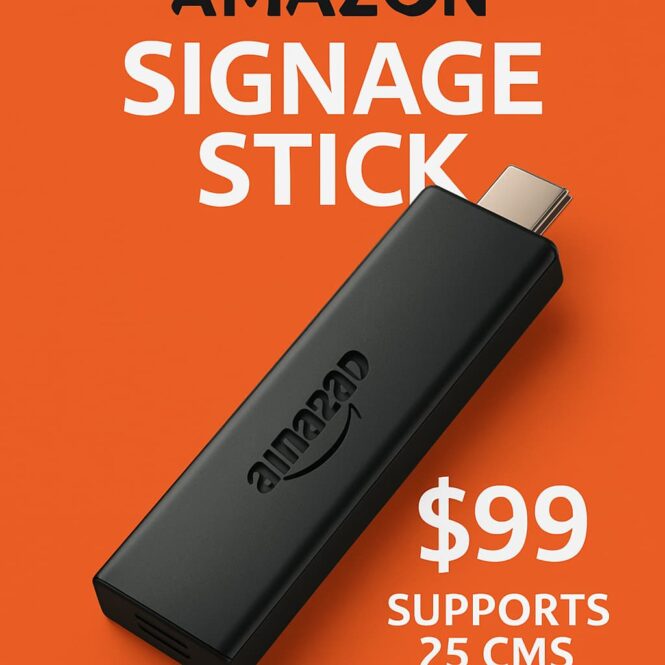
Media Player pre-loaded with support for 25 leading Content Management Systems (CMS)
Amazon’s newly launched Signage Stick represents a significant shift in how digital signage is delivered to businesses, leveraging the familiar Fire TV Stick design while targeting professional markets. This new device sheds its entertainment roots and refocuses on providing an affordable, robust, and easy-to-use platform for digital displays aimed at commercial users, such as businesses, universities, retail stores, restaurants, and small to medium enterprises.cordcuttersnews+2
Key Features and Differentiators
The Amazon Signage Stick is purpose-built for digital signage, not multimedia streaming. Outwardly, it closely resembles the second-generation Fire TV Stick 4K Max, using the same quad-core processor, 2GB RAM, 16GB of storage, and supporting Wi-Fi 6E. However, the critical difference lies in its firmware. Where standard Fire TV sticks are loaded with apps for streaming and home entertainment, the Signage Stick is optimized to auto-launch and lock into digital signage software, bypassing the home screen and other consumer features. Amazon’s firmware tweaks ensure a professional plug-and-play experience designed for deploying anything from a single sign to a vast digital signage network.martechcube+1youtube
The device comes pre-loaded with support for at least 25 leading Content Management Systems (CMS), including big names like Yodeck, PosterBooking, NoviSign, ScreenCloud, and others. This out-of-the-box compatibility allows businesses to get their displays running with minimal configuration. PosterBooking, for instance, offers a complimentary one-year unlimited license subscription for all Signage Stick buyers.sixteen-nine+1
Deployment and Setup
Amazon has refined the setup process to be fast and straightforward—even for those without technical expertise. Rather than requiring an Amazon account log-in and complex configuration, a user simply plugs the device into a TV or display, powers it up, connects to Wi-Fi, selects the preferred CMS platform, and enters a code shown on the screen at the relevant CMS portal. The system then pairs automatically, and thanks to its firmware, it securely boots directly into the signage platform, skipping all consumer media menus found on standard Fire TV devices.youtubesignage.amazon
The deployment time has significantly dropped—what once used to take up to 45 minutes per device for Fire TV Sticks in a business environment can now be done in about 10 minutes with the Signage Stick. This is a substantial operational improvement, especially when scaling to multiple screens across a business or campus environment.signage.amazon
Security, Reliability, and Updates
Built with commercial deployments in mind, the Signage Stick features a secure boot loader, robust data encryption, regular security updates, and the elimination of unnecessary features that could pose vulnerabilities. It is hardened for uptime and runs software in kiosk mode, ensuring the device only serves its digital signage purpose without user tampering or accidental exits. The regular firmware updates offer peace of mind and consistent performance, important for businesses relying on always-on messaging or advertising.sixteen-nine
Business Implications
Previously, many small and mid-sized businesses used standard Fire TV Sticks as low-cost digital signage solutions, even though these devices were designed for consumer use. This led to recurring issues—glitches after updates, inability to launch in kiosk mode reliably, and long setup times. By launching a specialized product, Amazon both legitimizes and streamlines the use of their devices for business displays.
The low price point—$99.99 per unit—sits well below most rival professional signage players, often priced from $150 to $300 each. This drastically lowers barriers for new adopters or those scaling up networks. Robust CMS integration means businesses can manage one or thousands of remote screens from a single dashboard, pushing new content, making instant updates, and monitoring the network’s health.martechcube+1youtube
Content Management System (CMS) providers have welcomed the device. For example, NoviSign worked closely with Amazon to ensure tight integration and sees the Signage Stick as lowering adoption barriers and quickly expanding the professional signage market. The tailored, secure nature of the hardware is seen as a major plus for both CMS providers and end-customers.sixteen-nine
Industry Impact and Future Potential
Amazon’s move is a response to how Fire TV devices were widely, but unofficially, adopted for signage before. The company noticed the sheer scale of indirect usage and instead of blocking it, doubled down to support these use cases officially. With this, Amazon enters the business hardware market more formally. By partnering with CMS vendors—especially those popular among small and medium businesses—Amazon ensures widespread market compatibility right at launch.
From coffee shops wanting menu boards, to offices sharing internal communications, to stores pushing promotions, more businesses now have a straightforward, cost-effective entry point into digital signage. Amazon’s recognition of third-party kiosks and large-scale CMS use-cases also means even very large businesses or universities (such as the University of Utah, cited in a case study as halving their deployment time) can now use a familiar, reliable, and supportable platform.signage.amazon
Conclusion
In summary, the Amazon Signage Stick is a purpose-built, professional, and secure solution for digital signage, combining low upfront costs with robust CMS compatibility. It strips away consumer-focused distractions and provides hassle-free setup, scalable deployment, and reliable operation for businesses of all sizes, reflecting Amazon’s commitment to meeting the evolving needs of business users. With this launch, Amazon is likely to become a major player in the digital signage hardware space, driving further innovation and expanding the accessibility of dynamic displays for businesses everywhere.